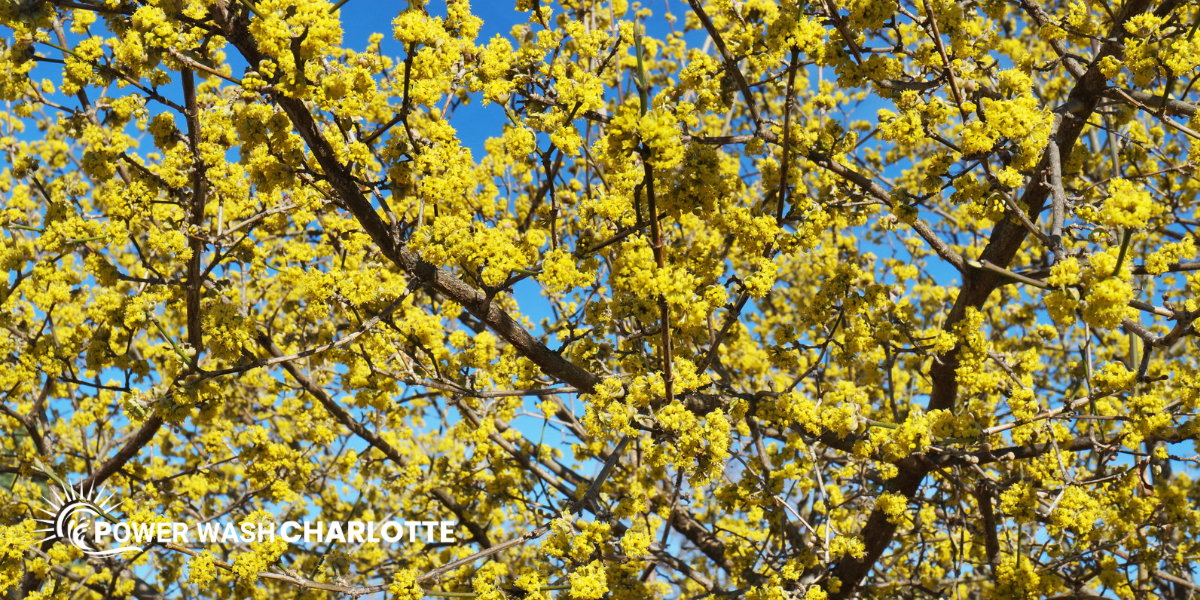
Pollen season in Charlotte runs from late February through late May, with pine peaking in the last two weeks of March and oak driving heavy deposits through April. The best window to schedule a professional house wash is the first two weeks of May, after all major tree cycles have finished and the surface film has settled for the final time before summer.
With nearly 30 years cleaning homes and businesses across Mecklenburg, Union, Cabarrus, and York counties, Power Wash Charlotte has tracked this cycle season after season. The calendar does not change much year to year. What changes is whether homeowners catch the right window or end up paying to wash twice.
Late March in Charlotte arrives with a yellow announcement. Pine pollen drifts off the tree canopy, settles onto rooflines, collects in gutters, and coats every horizontal surface. By the first week of April the entire metro smells of pine. A house washed during this window will be recoated within 48 hours. Getting the timing right is the difference between a wash that holds for eight months and one that needs to be redone before June.
What Does Charlotte’s Pollen Calendar Look Like Month by Month?
Charlotte’s spring pollen season moves in three overlapping waves. The timing shifts by a week or two based on winter warmth, but the sequence is consistent every year.
| Month | Primary source | Exterior impact | Wash recommendation |
|---|---|---|---|
| Mid-Feb to mid-March | Cedar, elm, maple | Light film; rinses with rain | Hold — main waves coming |
| Late March to early April | Pine (loblolly, Virginia) | Heavy yellow dust; coats all surfaces | Do not wash yet |
| April | Oak, hickory | Dense layering; worsens north walls | Wait for oak to finish |
| Late April to mid-May | Sweetgum, poplar, grass | Final deposits | Prime window: book here |
| June through August | Algae and mold (secondary) | Green growth on shaded walls | Catch before this stage |
| Sept to Oct | Ragweed and mold | Lighter; focuses on decks, patios | Secondary wash if needed |
Pine pollen is the fine yellow-green dust produced by Charlotte’s loblolly and Virginia pines during the last two weeks of March and first days of April. According to NC State Extension’s guide to pine pollen in the Piedmont,
a single mature pine tree can release up to a pound of pollen per season. Charlotte’s urban tree canopy covers an estimated 47% of the city’s surface area, which means per-square-foot deposits on siding and rooflines are among the highest of any major southeastern metro.
Which Charlotte Neighborhoods See the Heaviest Pollen?
Tree density determines pollen load, and Charlotte’s oldest neighborhoods have the densest canopy.
Myers Park and Eastover sit under a cathedral of willow oaks, water oaks, and mature pines. During April, these streets can re-accumulate a visible pollen film within 24 hours of a rinse. One spring wash in late April is often not enough; early May is the cleaner bet.
Dilworth and Madison Park carry similar canopy density. Dilworth’s craftsman bungalows and brick cottages see heavy deposits on north-facing and east-facing walls because surrounding oaks block drying sun on multiple exposures at once.
Plaza Midwood and NoDa trend slightly lighter thanks to newer streetscape development, but older blocks along the LYNX corridor still carry serious tree canopy pollen loads.
Newer subdivisions in Ballantyne, Huntersville, and Indian Trail have thinner tree canopy and clear faster. A single spring wash in those areas typically holds through summer. Homes under 30-year-old oaks in the older neighborhoods are different.
How Does Pollen Affect Your Home’s Exterior Surfaces?
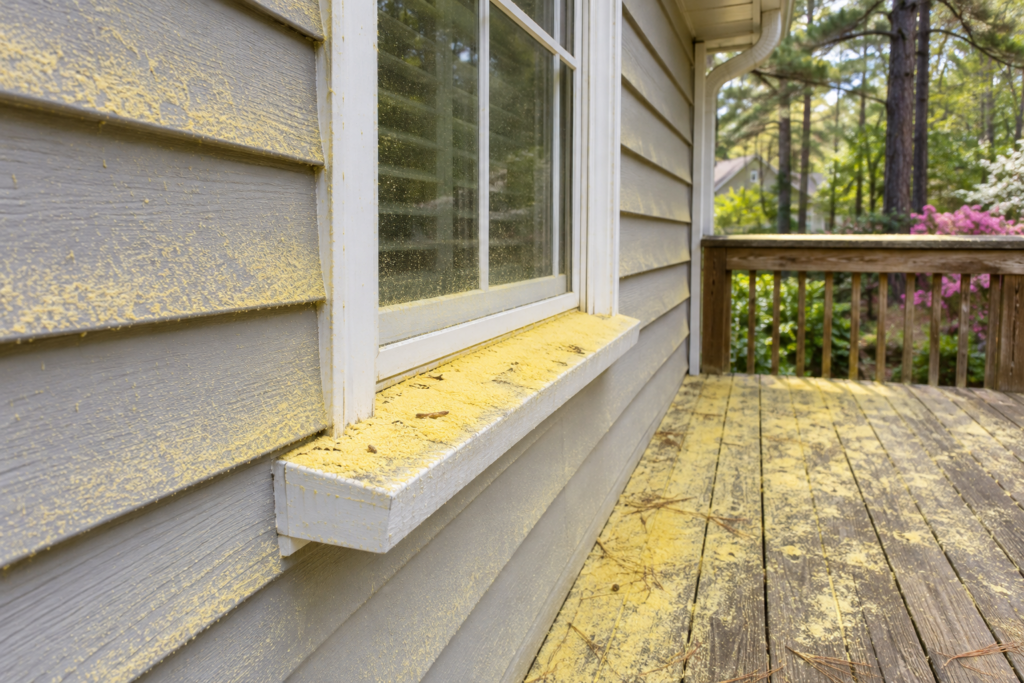
Pollen season is the period from late February through late May when Charlotte’s pine, oak, maple, and sweetgum trees release airborne pollen, creating the highest demand for exterior house washing of the year. The surface damage is not from the pollen itself but from what it does to the wall over time.
Pine pollen’s waxy coating causes it to stick to vinyl, fiber cement, and brick, then trap moisture against the surface. That moisture and organic matter feeds algae. Homes that skip the spring wash consistently develop green growth on north and east walls by July. Once the algae takes hold, it costs more to remove than the spring wash would have.
On painted surfaces and Hardie board, pollen left through multiple rain-and-dry cycles in April and May becomes progressively harder to remove. Each rain pushes some pollen into the surface pores; each dry day bakes it slightly. After three or four cycles, the film requires a full soft wash rather than a simple rinse.
For a full breakdown of how pollen and mildew interact on north-facing siding specifically, our guide to north side mildew on Charlotte homes covers the year-round pattern and why spring deposits set up the summer algae problem.
When Is the Right Window to Schedule Your Charlotte Spring House Wash?
The target window is the first two weeks of May. By then, pine, oak, and maple have all completed their cycles. A wash in this window gives the surface the longest clean stretch before the summer algae season begins, and it stays cleaner than a wash timed during active pollen drop.
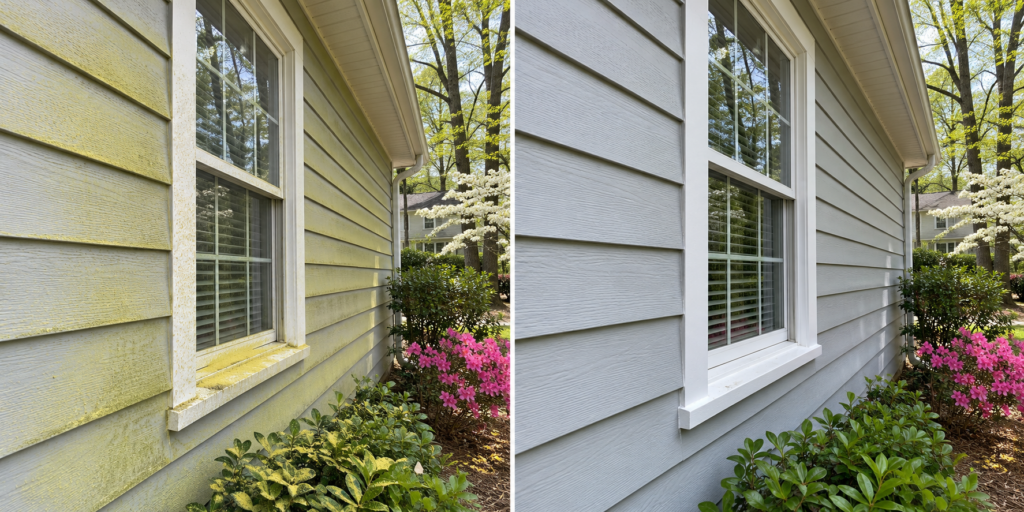
We washed a home in Madison Park during the first week of May, just after the heaviest spring pollen had settled. The siding had a thick yellow-green film, with pollen clinging to patches of existing mildew along the shaded side of the house. Our team soft washed the exterior, clearing away the buildup and revealing the siding’s original color.
Avoid washing during active pollen drop. A wash in late March will be recoated within 48 to 72 hours. Even in late April, oak pollen is still falling heavily in Myers Park and Eastover. If you cannot get to the May window, the second-best opening is late September through mid-October, after Charlotte’s ragweed and mold season peaks and before leaf drop begins.
For the full year-round cleaning calendar by season and surface, our Charlotte house washing schedule guide covers what to prioritize in each quarter. And when you’re ready to book, our Charlotte house pressure washing service gets a same-day quote in most cases.
Frequently Asked Questions About Pollen Season House Washing in Charlotte NC
Charlotte’s tree pollen season runs from late February through late May. Pine peaks in the last two weeks of March and first days of April. Oak and hickory follow through April into early May. Sweetgum and poplar wrap up in mid-May. A secondary fall wave of ragweed and mold runs from September through October but is lighter than the spring peak.
Rain rinses loosely deposited pollen from smooth surfaces but pushes pollen into textured siding, brick mortar joints, and window screen tracks at the same time. After the rain dries, the embedded film is often harder to remove than the original deposit. A professional soft wash with the right cleaning agent removes the surface pollen and the residue that rain cannot reach.
Pine pollen itself is not corrosive, but its waxy coating traps moisture against siding surfaces and provides an organic food source for algae and mildew. Homes that skip the spring wash consistently show green growth on shaded walls by July or August. Catching the pollen before it binds saves the cost of treating established algae later.
A garden hose can clear loose pollen during the active season, but it will not remove the waxy film that pine and oak pollen leave on vinyl and painted surfaces after two or more rain-and-dry cycles. High-pressure rinsing risks surface damage on vinyl and fiber cement siding. A soft wash with a sodium hypochlorite-based cleaning agent is the safe and lasting solution.
A wash timed in the first two weeks of May, after all major pollen cycles have finished, typically stays clean for six to ten months. Homes under heavy oak canopy in Myers Park, Eastover, or Dilworth may see earlier re-growth and benefit from a fall touchup. A wash during active pollen season will need to be redone within four to six weeks.
Need a quote for your home or property? Call Chris and the Power Wash Charlotte team at (704) 393-7773 or get your free quote.