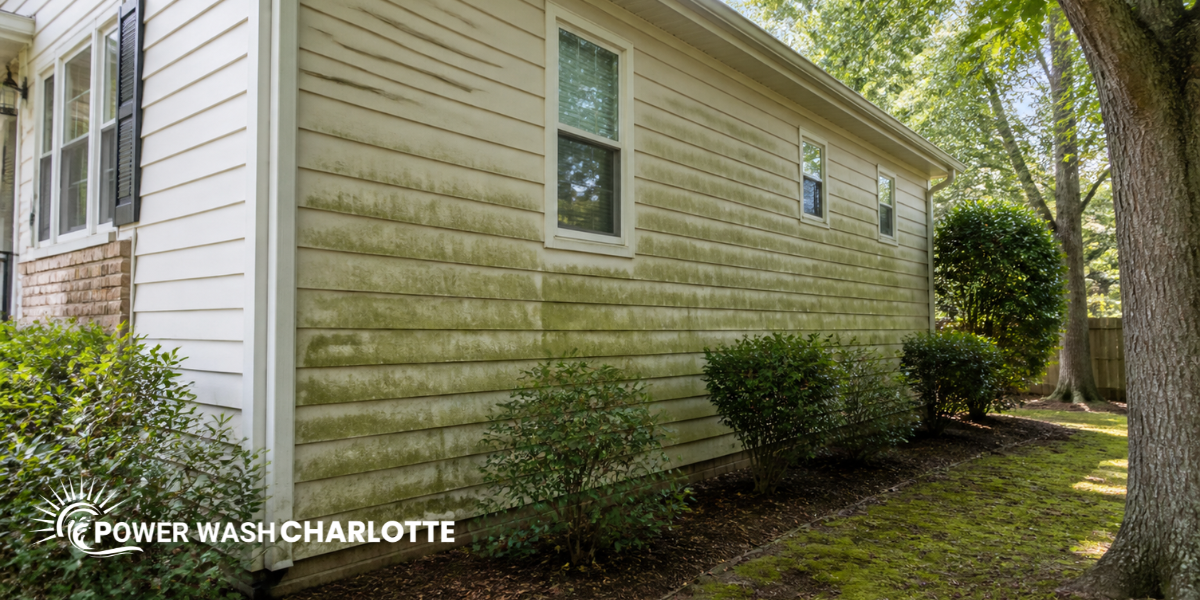
The north side of a Charlotte home turns green before any other wall because it receives the least direct sunlight and stays damp the longest. Algae and mildew take hold on shaded, moist surfaces within one to two seasons. Soft washing with the right cleaning agents removes the growth safely and keeps vinyl, brick, and fiber cement siding intact.
Serving the Charlotte metro since 1996, Power Wash Charlotte has built a reputation on doing the job right the first time. After nearly three decades cleaning homes from Dilworth to Cornelius, our team can tell from the driveway which direction a house faces. The north wall is almost always the one with the problem.
Walk around your Charlotte home in late April and the answer shows up on the wall. The south and west sides look fine. The north side is green. Homeowners ask us the same question every spring: if rain falls on all four sides, why does only the north one turn that color? The answer has everything to do with sunlight, moisture, and a climate that gives algae and mildew exactly what they need.
What Is That Green Growth on the North Side of Your Charlotte Home?
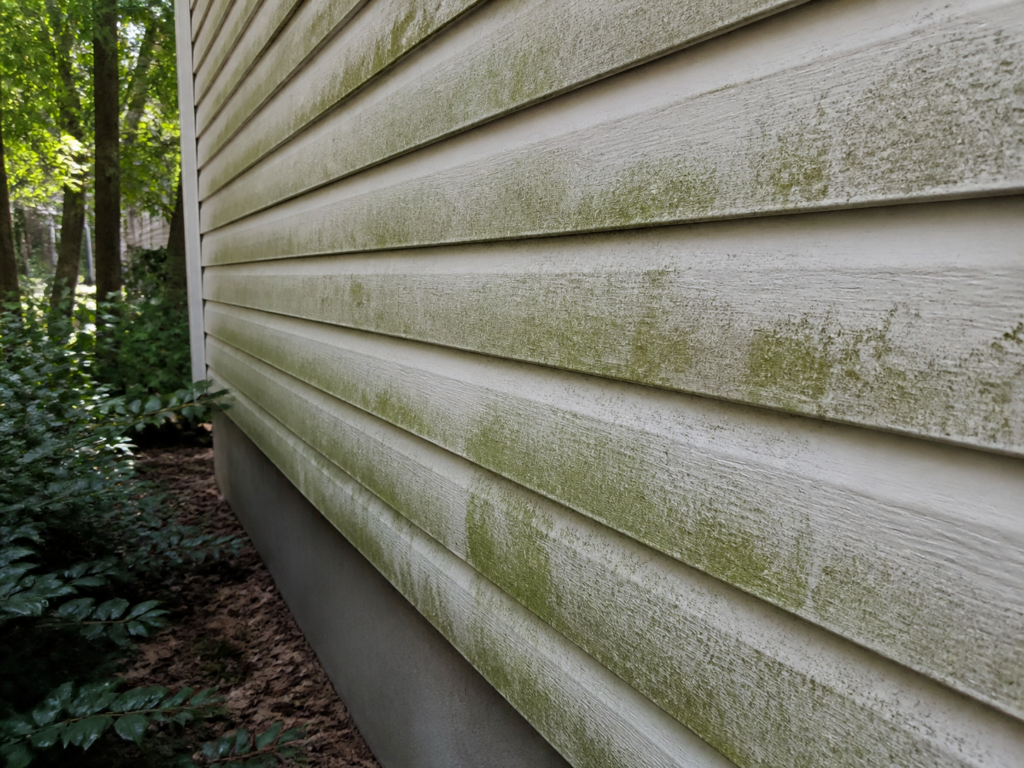
Green algae is a single-celled organism that attaches to porous and semi-porous surfaces, feeds on moisture and airborne dust, and reproduces rapidly in low-light conditions. Mildew on siding is a surface fungal growth that thrives in shaded, damp spots. Both are common on Charlotte home exteriors, and both are usually present at the same time. The green-gray film running along your north wall is typically a mix of the two.
What matters is that both are organisms, not stains. A garden hose or a quick brush scrub removes the surface layer but leaves the root system inside the siding pores. Within weeks the wall looks green again, sometimes worse.
On vinyl, algae and mildew show as a dusty gray-green film. On fiber cement (Hardie board), they settle into the textured finish and can penetrate the factory paint if left untreated across multiple seasons. On older brick mortar in neighborhoods like Myers Park and Eastover, growth in the joints can stain permanently without early treatment.
Why Does the North-Facing Wall Go Green Before the Others?
Three conditions drive algae and mildew growth on exterior siding: sustained moisture, shade, and organic material. The north side of any home in the Northern Hemisphere concentrates all three.
- Shade: The sun tracks across the southern sky, so south-facing surfaces receive direct light and dry completely most days. North-facing walls stay in shade for the majority of daylight hours. In tree-canopy neighborhoods like Dilworth and Madison Park, north walls can go days without meaningful direct sun even in summer.
- Moisture: Charlotte averages 43 inches of rainfall per year. Average humidity climbs to 74% in August, and morning humidity regularly exceeds 87% during summer. A north-facing wall that drained after a midnight rain is still damp at 10 a.m. That four-to-six-hour damp window is enough time for algae to establish a foothold.
- Organic material: Pollen, soil particles, and airborne leaf debris settle on exterior surfaces and give algae a food source. Charlotte’s tree canopy, particularly the willow oaks along the streets of Myers Park and the mature plantings in Eastover, deposits heavy pollen and leaf tannin each season. A thin film of organic matter on a shaded, moist wall creates near-ideal conditions for growth.
The result: south and west walls on a Charlotte home may stay clean for two to three years, while the north wall can show visible green growth within one season after a cleaning, especially on lots with dense tree cover near drainage areas or detention ponds.
Does the Type of Siding on Your Home Change How Serious the Problem Gets?
Yes, and it also determines how the wall should be cleaned. Each major siding type in Charlotte responds differently to algae growth and has different pressure tolerances.
| Siding Type | Algae/Mildew Vulnerability | Safe PSI Ceiling | Cleaning Method |
|---|---|---|---|
| Vinyl | High, porous surface texture holds moisture | 600-800 PSI | Soft wash with sodium hypochlorite blend |
| Fiber cement, Hardie board | Moderate to high, textured finish traps growth | 500-700 PSI | Soft wash; avoid direct pressure on lap joints |
| Painted brick | Moderate, growth in mortar joints and paint layer | 800-1,000 PSI | Soft wash; no acid-based cleaners on mortar |
| Unpainted brick | Lower, kiln-fired surface is less porous | 1,000-1,200 PSI | Soft or low-pressure wash; thorough rinse |
| Stucco | High, rough texture traps debris and moisture | 400-600 PSI | Soft wash only; high pressure cracks the finish |
Exceeding the safe PSI ceiling does not remove algae more effectively. It can crack a vinyl panel, drive water behind a lap joint, abrade the fiber cement finish, or blast mortar out of brick joints. Power Wash Charlotte’s Charlotte house washing guide walks through each siding type in more detail, including the surface-specific signs that a previous cleaning was done at too high a pressure.
Why Does High-Pressure Washing Alone Make the Problem Come Back Faster?
High pressure removes visible growth from the surface but not the roots embedded in the siding material. Within two to four weeks, the same wall is green again, sometimes worse, because the pressure blast opens micro-abrasions in vinyl and painted surfaces that give algae more surface area to grip on the next cycle.
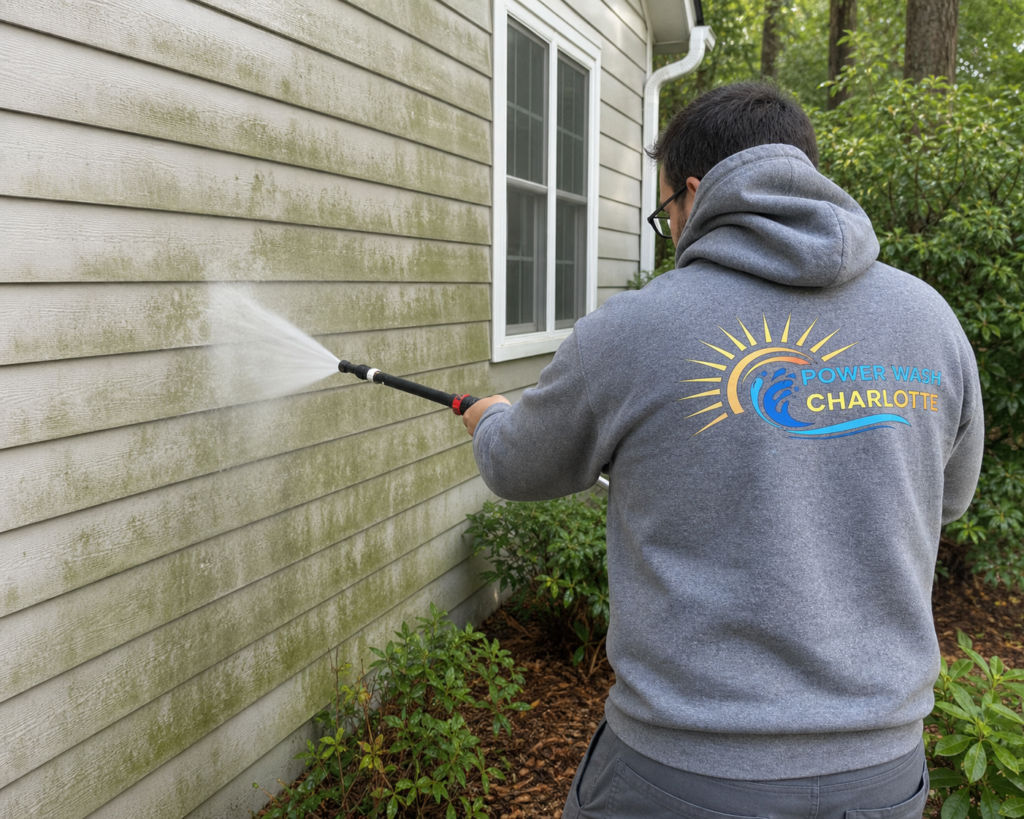
A soft wash is a low-pressure cleaning method that delivers a diluted sodium hypochlorite-based solution at under 250 PSI to penetrate siding pores, kill the organism at the root, and rinse clean without damaging the surface. That distinction, killing versus blasting, is why professional soft washing produces results that last 12 to 18 months rather than two to four weeks.
We recently visited a Madison Park home where a prior vendor had blasted the north-facing Hardie board with too much pressure, leaving the wall looking cleaner for a few weeks but opening several lap joints and letting moisture sit behind the siding. During our pre-job walk, our team found mildew already returning along the seams because the growth had never been treated at the root. We switched the homeowner to a proper soft wash, gave the solution time to dwell, and rinsed at low pressure so the siding dried clean without adding more damage.
According to NC State Extension’s guide on preventing mold in your home, removing the moisture source and eliminating the organism, not just the visible discoloration, is what stops recurrence. Masking the surface with pressure alone is not a lasting fix in Charlotte’s climate.
What Does a Professional North-Wall Soft Wash Actually Involve?
Our team walks the property before starting and notes any areas where water should not penetrate: open seams, window trim with compromised caulk, exterior electrical outlets. We cover or move anything sensitive near the foundation. Then the cleaning follows a consistent process:
- Step 1: Application: We apply a diluted sodium hypochlorite blend at low pressure to the north wall and any adjacent shaded surfaces, such as the east soffit line or a covered side patio. Dwell time is 10 to 15 minutes, long enough for the solution to penetrate the surface and kill the organism.
- Step 2: Low-pressure rinse: We rinse from the top down, staying well below the PSI ceiling for the siding type on that property. The rinse removes the dead organic matter.
- Step 3: Property walk: We walk the cleaned wall with the homeowner, confirm the result, and note any areas that need a second application. We also call out maintenance items spotted during the job: open caulk joints, loose trim, gutter debris sitting against the north roofline. These go into a written summary before we leave.
On a typical Charlotte home, the full north-wall process takes one to two hours. Heavy buildup present for two or more seasons may need a second pass. For homeowners responding to an HOA letter, our team can typically complete the work within 48 hours of scheduling, well inside the compliance window most Mecklenburg County associations allow. More on that timeline in our 14-day HOA mildew compliance guide for Charlotte homeowners.
How Often Should You Clean the North Side of Your Charlotte Home?
For most Charlotte homes, once per year is the right cadence for north-facing walls in neighborhoods with significant tree cover: Myers Park, Dilworth, Eastover, Foxcroft, and the established lots along the Olde Providence and Quail Hollow corridors. Homes with less canopy and more open-lot sun exposure may hold up on an 18- to 24-month schedule.
Timing matters. Late winter or early spring, before Charlotte’s pollen peak in the last week of March, is the best window. Removing the algae that built up over the dormant season before it reproduces in the warm months means you start pollen season with a clean surface. It also means the house looks its best through May, when HOA inspectors are most active across Charlotte and Mecklenburg County.
For homes near detention ponds, heavily wooded drainage areas, or lots with tight-canopy cover, a fall pass before leaf drop is worth adding. Leaves that settle against the north foundation and collect in corner trim joints feed mildew through the winter. Clearing that organic material before it breaks down reduces the spring growth load significantly.
When you’re ready to schedule a professional house washing in Charlotte, Power Wash Charlotte gives a same-day quote in most cases, answers the phone, and shows up when scheduled.
Frequently Asked Questions About North Side Mildew on Charlotte Homes
Why does the north side of my Charlotte home go green and the south side stays clean?
The south-facing wall receives direct sun for several hours each day, which dries the surface and prevents the damp, low-light conditions algae need to take hold. The north side stays shaded most of the day, retains moisture significantly longer, and collects organic dust from pollen and tree debris that feeds the growth. Charlotte’s humid subtropical climate, with morning summer humidity regularly above 87% and 43 inches of annual rainfall, amplifies the effect compared to drier regions.
Is the green growth actually damaging my siding, or is it mainly a cosmetic issue?
Over time, it is damaging. Green algae produces mild acids as part of its growth cycle, which can slowly etch painted surfaces. On fiber cement like Hardie board, sustained growth can eventually reach the factory finish layer and compromise the paint bond. Mildew embedded in brick mortar joints contributes to mortar softening over several years. Getting ahead of growth before it reaches that stage costs far less than repainting or repointing.
Can I clean north-side mildew myself with bleach from the hardware store?
Diluted household bleach can kill surface mildew, but without the right dwell time, dilution ratio, and a low-pressure delivery method, it often does not penetrate the pores where the root system lives. Scrubbing pushes growth deeper into porous siding materials. Spraying with a garden hose at too high a pressure risks surface abrasion on vinyl and fiber cement. A professional soft wash system delivers the solution at the correct concentration and removes the dead organism without damaging the surface.
Will the cleaning solution hurt the plants along my north foundation?
Power Wash Charlotte covers foundation plantings and any landscaping within the splash zone before applying solution, and rinses the surrounding area with clean water after the work is complete. With proper prep, plants along the north foundation are protected throughout the cleaning. We also flag any existing drainage issues that could cause soil runoff during the rinse step.
How long will my north wall stay clean after a soft wash?
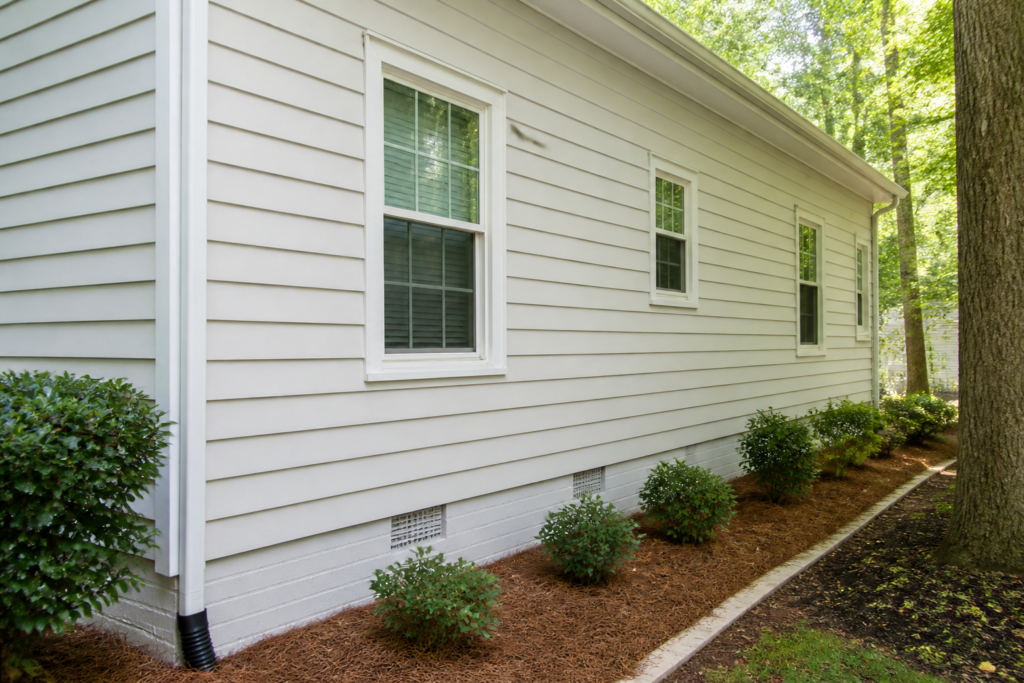
On most Charlotte homes, a professionally soft-washed north wall stays clean for 12 to 18 months. Heavily shaded lots near mature tree canopy or water features may see regrowth in 9 to 12 months. Because a soft wash kills the organism at the root rather than blasting off the surface layer, results last significantly longer than scrubbing or a garden-hose rinse.
Need a quote for your home or property? Call Chris and the Power Wash Charlotte team at (704) 393-7773 or get your free quote.
By Chris Earll, Owner of Power Wash Charlotte
Chris Earll is the owner of Power Wash Charlotte (Cutting Edge Restoration Inc), serving the Charlotte metro since 1996. He and his team have completed thousands of residential and commercial pressure washing projects across Mecklenburg, Union, Cabarrus, Iredell, Gaston, Lancaster, and York counties.