For asphalt shingles, pressure washing voids manufacturer warranties, accelerates granule loss, and shortens shingle life by years. The correct method is soft washing: a low-pressure application of a diluted sodium hypochlorite solution that kills algae at the biological root without stripping the shingle surface. ARMA, GAF, and Owens Corning all specify this in their published cleaning guidelines.
As an active member of the Better Business Bureau and the Greater Charlotte Apartment Association, Power Wash Charlotte has cleaned roofs across Mecklenburg, Union, Cabarrus, and York counties for nearly 30 years. When homeowners in Myers Park, Foxcroft, Ballantyne, and the Mooresville area call about black streaks on their shingles, the conversation almost always starts the same way: “Can’t I just rent a pressure washer and do it myself?” The short answer is no, and the three largest shingle manufacturers in North America are the ones who say so.
Manufacturer-approved roof cleaning is any cleaning method explicitly sanctioned by the shingle manufacturer in writing, typically described in the product’s limited warranty documentation or technical bulletin. This guide walks through what ARMA, GAF, and Owens Corning actually publish about cleaning asphalt shingles, explains the science behind why pressure causes damage, and shows how Charlotte’s specific climate makes the soft wash formula slightly different here than in drier regions.
What Does ARMA Actually Recommend for Cleaning Algae Off Asphalt Shingles?
The Asphalt Roofing Manufacturers Association (ARMA) represents the producers of more than 80% of asphalt roofing products sold in the U.S. Their published guidance on algae and moss removal is clear: do not pressure wash asphalt shingles.
ARMA’s recommended cleaning method is a low-pressure rinse using a diluted bleach solution, applied from the ridge line down. The solution is typically a 50/50 mix of water and liquid chlorine bleach with a small amount of surfactant. It is applied gently, allowed to dwell for 15 to 20 minutes, and then rinsed with low pressure. ARMA explicitly notes that scrubbing or high-pressure washing damages shingles and should not be used.
This is essentially what professional soft washing companies do, scaled to commercial volume and with tighter quality control over concentration, dwell time, and plant protection. The difference between a homeowner spraying diluted bleach from a garden sprayer and a professional soft wash crew is not the chemistry. It is the equipment, the training, and the detail work on either side of the application.
What Do GAF and Owens Corning Say About Pressure Washing in Their Warranties?
GAF is the largest roofing manufacturer in North America, and its Timberline series is among the most-installed shingles in the Charlotte market. GAF’s warranty documentation addresses cleaning directly: improper cleaning methods can affect warranty coverage, and pressure washing is specifically identified as a method that strips granules and can void coverage for premature granule loss.
Owens Corning’s limited warranty and homeowner care documentation takes the same position. Their Trudefinition Duration, Oakridge, and Berkshire collections all reference cleaning in product care guides. The guidance aligns with ARMA’s: use a low-pressure bleach-and-water solution, rinse gently, and avoid pressure washers.
The pattern across all three organizations is consistent. Every major shingle manufacturer specifies soft washing because they understand what granule loss does to long-term shingle performance. Granules are the shingle’s UV shield. Lose them early and the asphalt beneath degrades faster, water resistance drops, and the shingle’s protective lifespan shortens significantly. No warranty covers self-inflicted damage from improper cleaning.
Why Does High-Pressure Water Damage Asphalt Shingles?
Granule loss is the mechanical stripping of the mineral aggregate layer on asphalt shingles, which reduces UV resistance and accelerates aging. It is the most common damage pattern caused by pressure washing a residential roof.
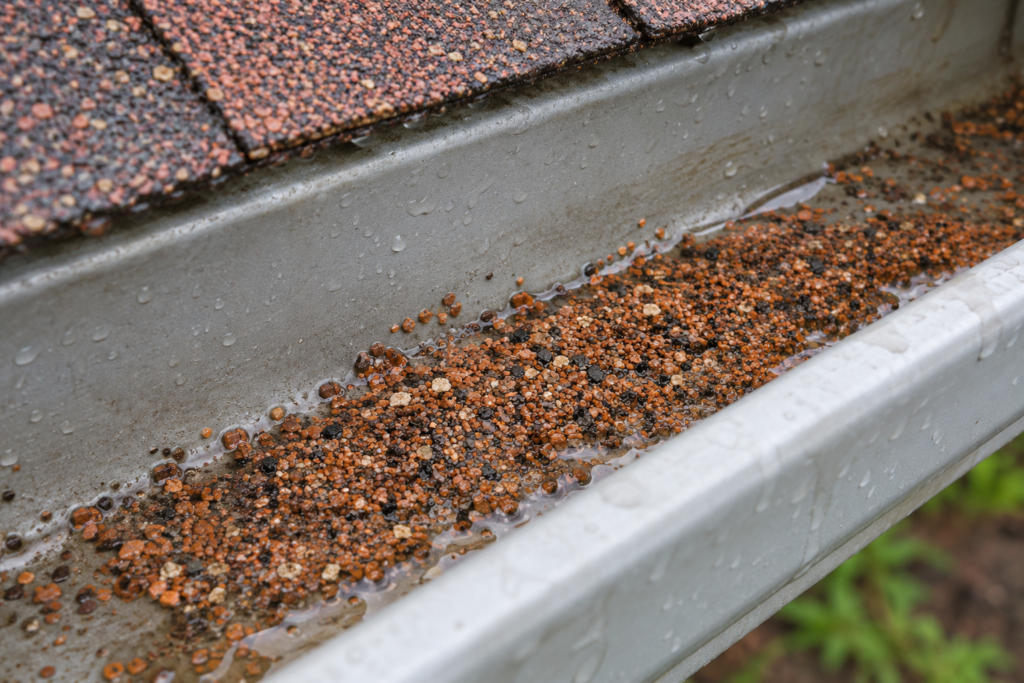
Asphalt shingles are layered: a fiberglass mat, an asphalt coating, and a top surface of crushed mineral granules embedded into that coating. A standard pressure washer running at 2,000 to 3,000 PSI does not distinguish between a concrete driveway and a shingle surface. On concrete, that force is appropriate. On shingles, it drives water under the granule surface, breaks the bond between granule and asphalt, and deposits those granules into your gutters.
Charlotte’s shingles face compounding thermal stress. Summer attic temperatures here can reach 150 to 165 degrees Fahrenheit on west-facing slopes, which softens the asphalt. Applying 2,000-plus PSI of water to a thermally expanded surface accelerates granule separation significantly. The evidence shows up in your gutters within a few days, looking like coarse sand or colored gravel. Within one to two seasons, pitting and premature streaking appear on the shingle surface itself.
A soft wash rig operates at 100 PSI or less at the nozzle, roughly equivalent to a garden hose on a gentle setting. It relies on chemistry rather than mechanical force.
What Is Soft Washing, and How Does It Work on a Roof?
Soft washing is a low-pressure cleaning method that uses a diluted sodium hypochlorite solution to kill algae, mildew, lichen, and moss at the biological root rather than blasting visible growth off with water pressure.
Here is what a professional soft wash on an asphalt shingle roof actually involves, step by step:
Walk-around and protection. The crew walks the property with the homeowner, notes skylights, solar panels, gutters, and landscaping near the drip line. Plants and shrubs are pre-wet with plain water before chemical application begins.
Chemical application. A sodium hypochlorite solution, typically 1 to 3 percent for standard algae and up to 5 percent for heavy lichen or moss, is applied from the ridge down using a low-pressure pump. The solution is distributed evenly and allowed to dwell.
Dwell time. The solution sits on the shingle surface for 10 to 20 minutes, killing the algae and mildew at the root level rather than only addressing surface discoloration.
Rinse. The roof is rinsed with low-pressure water. Because the organisms are dead rather than displaced, the streaks do not return with the next rain.
Plant rinse. Landscaping is rinsed again to clear any cleaning solution that drifted onto leaves or grass during application.
Our team walks the property with the homeowner before starting and again after the work is complete, confirming the result meets expectations before we leave.
How Does Charlotte’s Climate Change the Soft Wash Formula?
Charlotte sits in a humid subtropical climate. Summer dewpoints regularly reach 65 to 72 degrees Fahrenheit, annual rainfall averages 43 inches, and north-facing shingles stay damp for 8 or more hours on most summer nights. That combination is exactly what Gloeocapsa magma is built for.
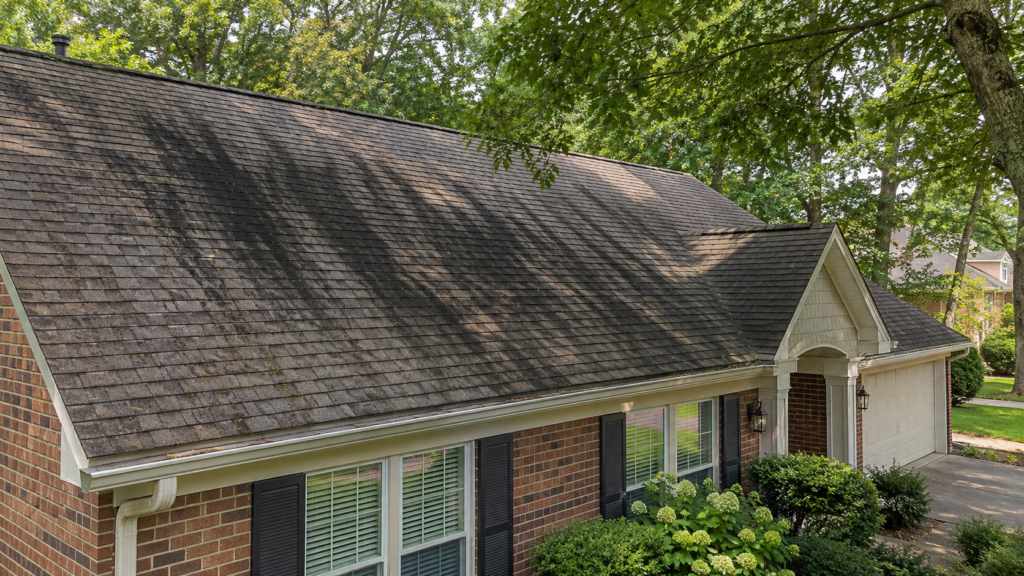
Gloeocapsa magma is the cyanobacterium responsible for the black streak staining visible on most Charlotte rooftops, feeding on the limestone filler in asphalt shingles and protected by a dark pigmented sheath that appears as streaks and discoloration from the street.
In drier climates, lighter sodium hypochlorite concentrations handle most algae growth. In Charlotte, experienced crews run slightly higher concentrations and plan for shorter reapplication cycles. Most professionally soft washed Charlotte roofs stay clean for two to three years. Roofs under heavy tree canopy in neighborhoods like Myers Park, Eastover, and Foxcroft, where the shade keeps the surface damp for extended periods, may need attention in 18 to 24 months.
We visited a Ballantyne home after the homeowner noticed black roof streaks while preparing to list the property. Heavy tree cover shaded one slope, where the buildup was especially noticeable. Our team soft washed the roof in a single visit, removing the dark staining and giving the home a cleaner appearance before listing photos.
What Should You Look for in a Charlotte Roof Cleaning Company?
Not every company that markets itself as a soft wash operation actually follows manufacturer guidelines. Here is what to verify before you book:
| Criterion | What to ask or check |
|---|---|
| Pressure method | Ask: “What PSI do you apply at the nozzle on asphalt shingles?” The answer should be 100 PSI or less. |
| Solution type | Ask: “What cleaning agents do you use?” Should reference sodium hypochlorite. Should not be undiluted bleach or a proprietary product with no disclosed ingredients. |
| Plant protection | Ask: “How do you protect landscaping?” Should describe pre-wetting plants before application and rinsing them thoroughly after. |
| Knowledge of manufacturer guidelines | A professional company should know that ARMA and major shingle manufacturers prohibit pressure washing. If the crew pushes back on this, move on. |
| Insurance | Confirm general liability and workers’ compensation coverage. Roof cleaning carries real exposure even when done from the ground. |
| Walk-around process | A credible company walks the property with you before starting and confirms the work meets expectations before leaving. |
Power Wash Charlotte’s crew carries full insurance, uses cleaning agents that are safe for plants and landscaping, and has been doing this work in Charlotte since 1996. We stand behind every job — if something is not right after we leave, we come back to fix it.
If you have already received an insurance non-renewal letter about roof algae, that post walks through the full decision tree and what to document for your carrier. You can also read more about why Charlotte roofs develop black streaks faster than most of the South for full context on the biology driving the problem. And if you are comparing cleaning methods for surfaces beyond the roof, the soft wash vs. pressure wash guide for Charlotte homes covers siding, driveways, and patios.
For specifics on what a professional job includes and how to request a quote, see the Charlotte roof cleaning service page.
Frequently Asked Questions About Roof Cleaning in Charlotte NC
Soft washing using the method ARMA and major shingle manufacturers specify does not void your warranty. Pressure washing, on the other hand, can void coverage for premature granule loss, which is one of the most commonly claimed warranty issues related to cleaning. Before scheduling any roof cleaning, pull your shingle manufacturer’s warranty documentation and check the specific cleaning language for your product line.
Most Charlotte homeowners need to clean asphalt shingle roofs every two to three years. Homes with heavy tree coverage in neighborhoods like Myers Park, Eastover, and Foxcroft may need attention every 18 to 24 months because the shade keeps the surface damp and accelerates Gloeocapsa growth. Roofs with zinc-treated or algae-resistant shingles can sometimes extend the interval, but algae still accumulates under Charlotte’s humidity conditions over time.
Done properly, soft washing does not damage gutters or landscaping. A professional crew pre-wets all plants and shrubs before application and rinses them thoroughly after the job is complete. Sodium hypochlorite at the concentrations used for soft washing is not harmful to vinyl, aluminum, or steel gutters when properly diluted and rinsed. If a crew skips the plant-protection step, that is a quality-of-work problem rather than an inherent risk of the method.
Scale, concentration control, and safety. A professional soft wash rig applies solution at a controlled concentration calibrated to the specific algae load and roof type, from a safe distance using appropriate equipment. A homeowner using a garden sprayer is working at uncontrolled concentration, typically without adequate plant protection, and without the experience to recognize when lichen versus standard algae requires a different approach. The typical result of the DIY method is uneven coverage, possible plant damage, and streaks returning within one season.
Need a quote for your home or property? Call Chris and the Power Wash Charlotte team at (704) 393-7773 or get your free quote.