Soft Wash vs. Pressure Wash: Which One Is Right for Your Charlotte Home?

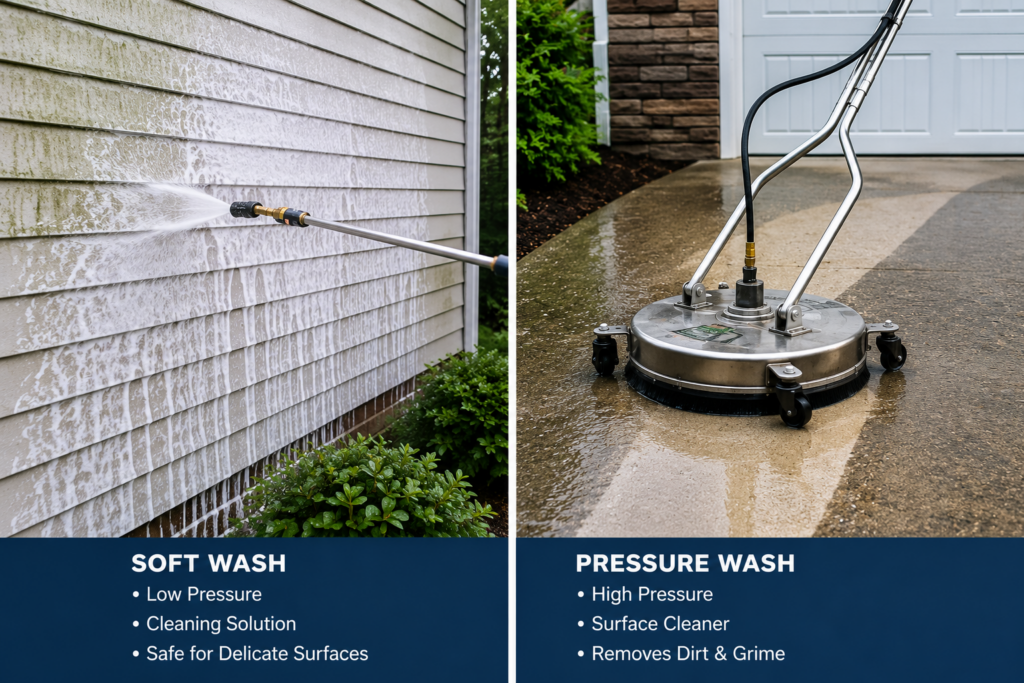
Soft washing uses low pressure (under 500 PSI) plus cleaning agents to safely lift algae, mildew, and dirt from siding, roofs, and wood. Pressure washing uses high pressure (1,500 to 4,000 PSI) and is right for concrete, brick hardscape, and dense surfaces. The wrong method on the wrong surface causes real damage, often invisible until it spreads.
 
Every spring in Charlotte, the same phone calls roll in. A homeowner rented a pressure washer, aimed it at the green mildew on the north side of their vinyl, and now has a wavy ripple across two panels and water somewhere behind the siding. Or they hired the lowest bidder, who walked the roof with a 3,000 PSI wand and stripped a path of granules off the asphalt shingles. These are not rare. They happen every week in Madison Park, Dilworth, Plaza Midwood, and out toward Matthews and Indian Trail.
 
Power Wash Charlotte’s seven-person team has completed thousands of projects across 19+ cities in NC and SC, and the single question we answer most is “which method is right for my house?” The answer is almost never one or the other. A clean Charlotte home usually needs both, applied to the right surface in the right order. This guide walks through what each method is, where each one belongs, and how to tell when a contractor is using the wrong tool on your home.

What is Soft Washing and How is it Different From Pressure Washing?

 
Soft washing is a low-pressure cleaning method that uses specialized cleaning agents at residential garden-hose pressure (typically under 500 PSI) to kill algae, mildew, and bacteria at the cellular level, then rinse them away. Pressure washing is a mechanical cleaning method that uses water force, usually between 1,500 and 4,000 PSI, to physically scour dirt, grime, and surface buildup off a hard surface.
 
The two methods solve different problems. Algae, mildew, and biological staining are alive and have to be killed and lifted, not pushed. Hitting a colony of Gloeocapsa magma on a shingle with high pressure spreads it sideways and removes shingle granules. Hitting mildew on vinyl with high pressure compresses the colony into the texture and drives water behind the panel.
 
Pressed-in surface grime on concrete is different. It is mineral and organic residue bonded to a dense, porous matrix, and that bond breaks with mechanical pressure. A soft wash on a year-old red-clay-stained driveway in Concord or Waxhaw leaves most of the staining in place. A surface cleaner at 3,000 PSI takes it off in 20 minutes.
 
A useful mental model: soft wash what is alive or fragile. Pressure wash what is dense and inert.

Which Charlotte Surfaces Need a Soft Wash, and Which Need Pressure?

 
Most Charlotte homes have a mix of both surface types. The table below is what we recommend after walking thousands of properties across Mecklenburg, Union, and Cabarrus counties.
 
SurfaceSoft WashPressure WashWhy
Vinyl sidingHigh pressure can force water behind panels and into the wall cavity.
Hardie or fiber-cement sidingA low-pressure rinse helps protect the finish.
Brick exterior walls✓ TypicalUse cautionAged mortar joints can fail under high pressure.
StuccoThe porous surface can chip under high pressure.
Wood siding or cedar shakesHigh pressure can splinter the wood and raise its grain.
Painted surfacesHigh pressure can strip paint and damage its protective film.
Asphalt-shingle roofHigh pressure can strip protective granules and affect warranty coverage.
Metal roofUse cautionPressure can dent the metal or scratch its coating.
Tile roofHigh pressure can crack tiles.
Wood deck✓ TypicalUse cautionHigh pressure can raise the wood grain.
Composite deckingHigh-pressure rinsing may damage the surface.
Concrete drivewayConcrete can generally withstand appropriate pressure and surface cleaning.
Concrete sidewalks and patiosThese surfaces can generally withstand appropriate pressure and surface cleaning.
Brick or paver hardscapeUse cautionExcessive pressure can remove sand from the joints.
Stamped or broom-finished pool deck✓ Pretreatment✓ RinseApply a cleaning solution first, then rinse using moderate pressure.
Gutter exterior brighteningA cleaning solution is needed to remove oxidation or “tiger stripes.”

This is the same table our crew runs in their head walking a property. A typical full-property visit in Madison Park or Olde Providence usually involves a soft wash on the house and roof, a pressure wash on driveway, walks, and patio, and a soft wash on the deck. Three methods, one visit, one truck.
Why Do Roof Manufacturers (ARMA, GAF, Owens Corning) Prohibit Pressure Washing Shingles?

The Asphalt Roofing Manufacturers Association (ARMA) and every major shingle manufacturer, including GAF, Owens Corning, and CertainTeed, explicitly recommend against pressure washing asphalt shingles. The rule is not arbitrary. It comes from the physical construction of the shingle.

An asphalt shingle is a fiberglass mat saturated with asphalt and coated with mineral granules. Those granules do three jobs: they protect the asphalt from UV degradation, they add fire resistance, and they create the visible color and texture of the roof. When water hits the shingle at 1,500 PSI or higher, granules dislodge. Once they are gone, the asphalt underneath ages in months instead of years.

A homeowner can usually see the damage two ways: the gutters fill with granules after the wash, and the affected slope ages visibly faster than the rest of the roof over the next few summers. By year five, the pressure-washed slope can be ready for replacement while the rest of the roof has another decade of life.

ARMA’s official recommendation is low-pressure application (under 500 PSI) of a cleaning agent solution with 15 to 20 minutes of dwell time, followed by a low-pressure rinse. That is exactly what a soft wash is. Anything else voids most shingle warranties.

What Can High Pressure Actually Damage on a Charlotte Home?

The damage list is longer than most homeowners realize. On vinyl siding, high pressure can crack panels, force water behind seams into the wall cavity, and discolor the surface in streaks. The vinyl damage itself is sometimes cosmetic, but the water that gets behind the panel can cause hidden mold and rot for years before anyone notices.

On wood (siding, cedar shake, decks, fencing), high pressure raises and splinters the grain, opening paths for water and rot. A pressure-washed cedar shake in Foxcroft or Eastover often has to be replaced rather than refinished.

On brick mortar, high pressure erodes older joints, especially on Charlotte’s pre-1940 brick homes in Dilworth, Plaza Midwood, and the Myers Park bungalow blocks. Once a joint fails, water has a path into the wall.

On windows, gaskets, and screens, high pressure can break seals on insulated glass units and push water past weather stripping. A homeowner who finds fogging between the panes after a summer wash has often caused it themselves.

On HVAC fins, electrical fixtures, and irrigation heads, high pressure crushes fins, drives water into junction boxes, and snaps off plastic risers. Each is an annoying $50 to $300 repair the homeowner did not plan for.

What Does a Soft Wash Mix Actually Contain, and is it Safe for Plants?

A soft wash solution is a three-ingredient mix: water, sodium hypochlorite (the same active ingredient in household bleach, at low concentration), and a surfactant that helps the solution cling to vertical surfaces.
 
Mix ratios depend on the surface. For vinyl, Hardie, brick, and painted surfaces, the working concentration of sodium hypochlorite is typically 1 to 2 percent, well below household bleach strength. Surfactant is added at roughly 1 to 2 percent of total volume. The solution dwells 10 to 15 minutes, then rinses cleanly with low-pressure water.
 
Plant safety comes from process. Our team walks the property before the wash and covers or moves sensitive plant beds within reach of the work area. We pre-wet the surrounding landscaping so any incidental drift dilutes immediately, and we rinse foundation plantings after the wash.
 
Done correctly, soft washing is the standard recommended for Charlotte homes by every siding and roofing manufacturer that publishes a maintenance specification. Done carelessly, any cleaning agent can damage plants. The difference is the process, not the bottle.

How Long Does a Soft Wash Last Compared to a Pressure Wash?

This is the part most homeowners get wrong. They assume “more pressure” equals “lasts longer.” It does not. A soft wash usually lasts significantly longer than a pressure wash on the same surface, because it kills the biology rather than just pushing it sideways.
 
ServiceMethodTypical Lifespan in Charlotte
House sidingSoft wash12–18 months before mildew returns on shaded areas
House sidingPressure wash—not recommended3–6 months; surviving organic growth may return quickly
RoofSoft wash3–5 years
RoofPressure wash—not recommended6–12 months, with a risk of permanent granule damage
Concrete drivewayPressure wash1–2 years, depending on tree cover and vehicle traffic
Wood deckSoft wash1–2 years before cleaning again for staining
Gutter exteriorBrightening and soft washing12–24 months
 
The lifespan column is why soft washing is the default residential method across the Charlotte metro. The humid subtropical climate grows Gloeocapsa and mildew anywhere there is shade. A surface pressure-washed without a biological kill looks dirty again before the invoice is paid off.

How Should You Tell a Real Soft-Wash Crew From a Contractor Cutting Corners?
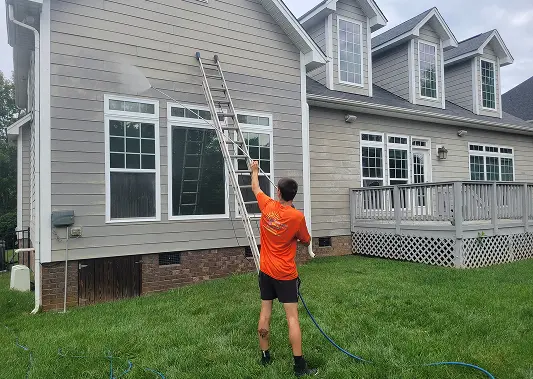
The fastest tell is the truck and the equipment. A real soft-wash crew arrives with a downstream injection setup or a dedicated soft-wash pump on the rig, separate hose reels for low-pressure work, and labeled containers of cleaning agent and surfactant. A contractor who pulled a consumer-grade pressure washer out of the garage on the way to your job is going to dial down the pressure and call it “soft washing.” It is not.
 
A few questions that surface the difference: ask whether the crew runs a downstream injector or a true soft-wash pump (a real setup has one or the other), ask what cleaning agent and surface concentration they will use on your siding (a real crew names sodium hypochlorite and the percentage), ask their plan for the landscaping in front of the work area (a real crew walks it with you first), and ask what happens if mildew comes back in 90 days (a real crew stands behind the work and comes back to fix it).
 
Our team answers the phone, walks the property with the homeowner before and after the job, gives a fair price upfront with no hidden fees, and stands behind every job. A contractor who cannot match that standard is the one charging less for a reason that shows up later.

Frequently Asked Questions About Soft Wash vs. Pressure Wash in Charlotte
 
Is soft washing the same as low-pressure washing?
 
Mostly. Soft washing specifically refers to the combination of cleaning agents plus low-pressure rinse. A plain low-pressure rinse with no cleaning agent will move surface dust but will not kill algae or mildew. The cleaning-agent step is what makes a wash a soft wash.
 
Will soft washing kill my grass or shrubs?
 
Not when the process is run correctly. Our team pre-wets, covers, and post-rinses the landscaping in the work area. The cleaning agent at working concentration is much weaker than household bleach, and dilution plus rinse keeps it from harming plants. The risk to landscaping comes almost entirely from poor process, not from soft washing itself.
 
Can I pressure wash my own driveway safely?
 
Yes, with the right equipment. A surface cleaner attachment, a 2,500 to 3,000 PSI machine, and a 25-degree tip for edging handle most Charlotte driveways. The common mistake is using a narrower tip too close to the surface, which leaves zebra stripes that take years to fade.
 
Can soft washing remove red clay stains?
 
Soft washing alone usually does not. Red clay staining is iron oxide bound to kaolinite clay, and breaking the bond requires a specific cleaning agent and either dwell time or mechanical agitation. Most red clay removal in Charlotte combines a cleaning-agent pre-treatment with a surface-cleaner pressure rinse.
 
What about windows during a soft wash?
 
A proper soft wash leaves windows cleaner than they started because the rinse is low-pressure and the cleaning agent does not damage glass or framing. We rinse the panes from below upward during the final pass.
 
Need a quote for your home or property? Call Chris and the Power Wash Charlotte team at (704) 393-7773 or get your free quote.
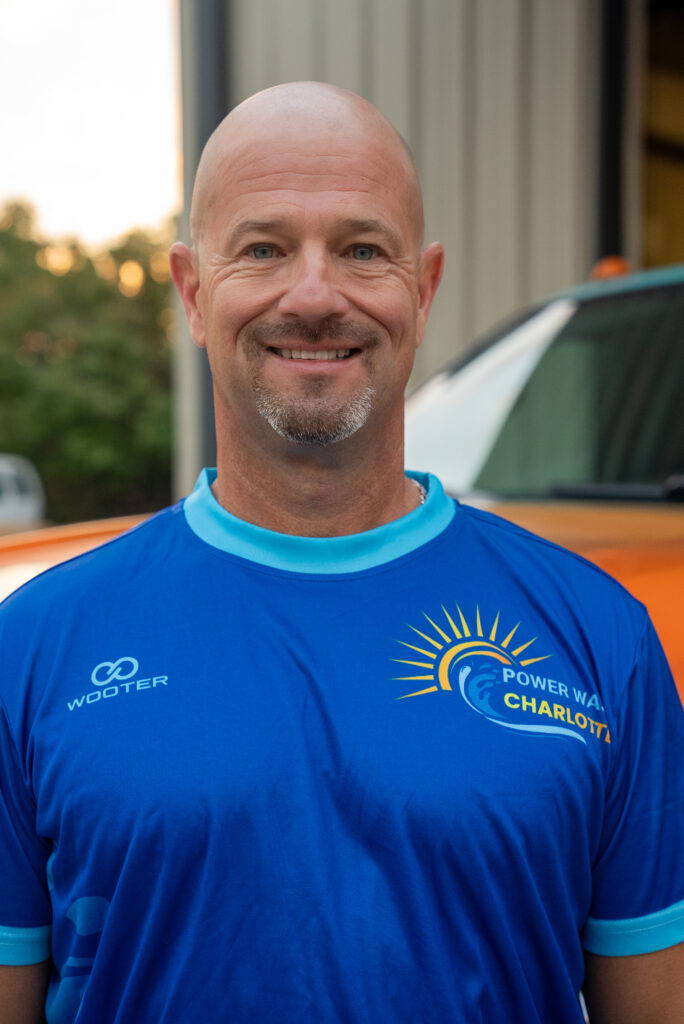
By Chris Earll, Owner of Power Wash Charlotte
 
Chris Earll is the owner of Power Wash Charlotte (Cutting Edge Restoration Inc), serving the Charlotte metro since 1996. He and his team have completed thousands of residential and commercial pressure washing projects across Mecklenburg, Union, Cabarrus, Iredell, Gaston, Lancaster, and York counties.
Chris Earll President - Sales and Marketing
CATEGORIES
table of contents
Share

CHECK OUT OUR CURRENT DISCOUNTS AND SPECIALS!