A Property Manager’s Vendor Checklist for Multi-Family Pressure Washing in Charlotte

Apartment pressure washing in Charlotte is the scheduled cleaning of multi-family community exteriors, including breezeways, stairwells, dumpster pad surrounds, sidewalks, parking areas, signage, building siding, and trash chute landings, using methods and pressures matched to each surface. The right vendor protects your insurance posture, your resident reviews, and your renewal numbers.
 
As an active member of the Better Business Bureau and the Greater Charlotte Apartment Association, Power Wash Charlotte has spent nearly three decades working with multi-family property managers, regional managers, and HOA boards across Mecklenburg, Union, Cabarrus, Iredell, Gaston, Lancaster, and York counties. We have learned that the difference between a clean community and a chronic resident complaint is rarely the cleaning itself. It is almost always the vendor selection process upstream.
 
Spring is when that process breaks down. By mid-March, every regional manager in Charlotte is staring at the same calendar. Spring inspections are starting, turnover season is ramping toward its July peak, and the breezeways and dumpster pads that looked acceptable in February now look obviously dirty in 75-degree daylight. If your vendor is not locked in by then, you are competing for May, June, and July slots against every other community in Ballantyne, SouthPark, University City, and the I-85 corridor. The checklist below is what we wish every property manager handed to vendors before signing.
PWC - Commercial Services - Multi-Family Property Power Washing

What does apartment pressure washing in Charlotte actually cover?

Multi-family pressure washing is not a single service. It is a portfolio of exterior cleaning tasks scheduled at different intervals, billed at different rates, and performed with different equipment. A vendor proposal that lumps all of it into one line item is almost always going to come back with surprise change orders.
 
A complete scope of work for a typical Charlotte garden-style or mid-rise community usually covers seven distinct areas. Breezeways and stair treads need pressure washing two to four times a year because foot traffic, spilled drinks, and pet accidents combine fast. Dumpster pad surrounds, which Power Wash Charlotte cleans around the pad itself rather than the dumpster, need monthly or quarterly attention to control odor and avoid health complaints. Building siding, whether vinyl, fiber cement, or brick, needs an annual soft wash to keep north-facing mildew off. Sidewalks and entry walkways collect pollen yellow in April and Gloeocapsa magma slime year-round on shaded sections. Parking lot oil drip lines, signage faces, and pool deck surfaces each have their own schedule and method.
 
Knowing what is in scope and what is not is the foundation of every other item on this list.

When should you have your spring vendor locked in?

The honest answer is January. The realistic answer is by the end of February. The latest workable answer for any Charlotte community that wants reliable May, June, or July service is mid-March.
 
The National Apartment Association notes in its curb appeal operational resources  that exterior presentation directly drives prospect tours, lease conversions, and online reputation, which is why spring is treated as showtime across the industry. The supply side moves the same direction at the same time. Charlotte’s multi-family inventory is large and growing, and every community on the I-77, I-85, and I-485 corridors is competing for the same handful of legitimate multi-family pressure washing vendors during the same eight-week stretch.
 
If you sign in January, you set your dates. If you sign in March, you take what is left. If you call in May with a turnover bottleneck and a leasing office that looks dingy, you are usually paying rush-rate pricing to whoever can fit you in, and the vendor pool gets smaller.

Step 1: What insurance and certificate of insurance terms should you require?

A Certificate of Insurance, often called a COI, is a one-page document from a contractor’s insurance carrier that lists policy limits, effective dates, and any additional insured endorsements naming your property and ownership entity. It is the single most important piece of paper in your vendor file, and the most common point of failure.
 
Industry research on multi-family vendor management consistently finds that a meaningful share of vendor COIs on file have material deficiencies, including expired dates, missing additional insured endorsements, and limits below contract requirements. For Charlotte multi-family work, the baseline you should require is straightforward.
 
CoverageMinimum RequirementNotes
Commercial General Liability$1M per occurrence / $2M aggregate$2M / $4M for Class A communities in Uptown, SouthPark, Ballantyne
Additional Insured EndorsementCG 20 10 ongoing + CG 20 37 completed opsMust name the property management company and the ownership entity
Workers’ CompensationStatutory NC limitsPlus Waiver of Subrogation in favor of the property
Employer’s Liability$1M / $1M / $1MStandard within most WC policies
Commercial Auto$1M combined single limitIf any vehicles enter the community
Umbrella$1M minimum; $5M for Class ARequired by most national PMC vendor portals
Primary and Non-ContributoryConfirmed on COIThe vendor’s policy pays first before yours

Beyond the COI itself, require a W-9 on file, an MSA or service agreement signed before mobilization, and a calendar reminder set 30 to 60 days before any policy renewal. Half of the multi-family COI failures we see come from a vendor whose policy lapsed three weeks before a job and no one noticed until a slip claim landed.

Certificate of Insurance document

Step 2: How should you define the scope and the surfaces in your contract?

The vendors who underbid and then file change orders are usually the ones the property manager described their needs to verbally. Write it down, surface by surface, and require the bid to follow your format.
 
A clean scope of work has six anchors. First, a per-surface description with approximate square footage or linear footage. Second, the method specified for each surface, such as soft wash for siding and roofs versus higher-pressure surface cleaning for concrete. Third, the cleaning agents identified by category, with a note that they are safe for plants and landscaping and that landscaping will be rinsed before and after. Fourth, the frequency, whether one-time, monthly, quarterly, or annual. Fifth, the access plan, including which gates open, who escorts the crew through resident parking, and whether after-hours work is permitted. Sixth, the deliverables, including before and after photos delivered within 24 hours of job completion and a signed walk-through document.
 
Power Wash Charlotte walks every multi-family property with the on-site manager before the first job and again after the work is complete. That walk-around is part of what is detailed on our Power Wash Charlotte difference page, and on a multi-family scope it is what catches the items a desk-bound RFP cannot, such as a back-corner stairwell that has not been cleaned in three years or a dumpster pad with a slow drain that needs to be addressed before pressure washing makes the standing water worse.

Step 3: What does a year-round cleaning calendar for a Charlotte community look like?

Reactive scheduling is what turns a $4,000 annual cleaning budget into a $12,000 emergency. A locked annual calendar prevents that. The calendar below is what we recommend for a typical 200-unit garden-style community in the Charlotte metro, adjusted for Charlotte’s specific climate, pollen peak, and Gloeocapsa magma growth window.
 
MonthServiceWhy This Timing Matters in Charlotte
FebruaryPre-spring breezeway + stairwell washSets baseline before March HOA-style inspections and spring tours
MarchDumpster pad refresh + sidewalk degreasePrep for April pollen peak; addresses winter grease and salt buildup
AprilPollen wash on signage, entry walk, leasing officeYellow pine pollen peaks last week of March + first week of April
MayBuilding soft wash, full perimeterCaptures north-side mildew before June humidity locks it in
JunePool deck pressure wash + algae treatmentPre-Memorial Day if pool opens early; slip-and-fall risk reduction
JulyMid-turnover breezeway + stairwell touch-upPeak turnover month nationally; protects unit walk-throughs
AugustDumpster pad + parking lot oil drip linesHeat amplifies dumpster odor; oil stains set permanently in summer sun
SeptemberRoof soft wash, selected buildingsOptimum window between summer storms and fall leaf drop
OctoberGutter cleaning + downspout flushPre-leaf-drop preparation; protects fascia and foundation
NovemberPost-leaf gutter pass + sidewalk decontaminationFinal clean before holiday hosting and winter
December-JanuaryMaintenance onlyCold-weather window; reserved for emergency calls

A calendar like this does two things. It distributes spend evenly across the operating budget rather than concentrating it in spring, and it makes the vendor responsible for showing up on a schedule rather than waiting for a complaint to drive a work order.

Step 4: What stormwater and resident-disruption rules should be in the contract?

Charlotte-Mecklenburg Storm Water Services treats pressure washing wash water as a regulated discharge. The City of Charlotte’s published guidance on acceptable practices for disposal of wash water from pressure washing defines what is allowed, what is prohibited, and where the liability falls if a non-compliant discharge reaches a storm drain. The short version is that detergents, oil, grease, and concentrated organic wash water cannot enter the storm system. Containment, recovery, or disposal to a sanitary sewer is required for most multi-family surfaces, especially dumpster pads, parking lots, and any area where vehicles park.
 
A multi-family scope should require, in writing, that the vendor follow Charlotte-Mecklenburg stormwater rules, carry the equipment to contain wash water around dumpster pads and parking areas, and indemnify the property if a Notice of Violation is ever issued for a job they performed. Property managers who skip this clause find out the hard way that a violation issued to the property owner takes months to unwind and creates an insurance file note that follows the property through its next sale.
 
Resident disruption is the other half of the contract. The standard we recommend is 48-hour written notice posted at affected breezeways, 7:30 a.m. to 4:30 p.m. work hours on weekdays only unless after-hours is specifically authorized, marked vehicles and uniformed technicians on the property at all times, and a single point of contact reachable by the on-site manager during the entire job.

Step 5: How do you tell a real multi-family vendor from a one-truck operator?
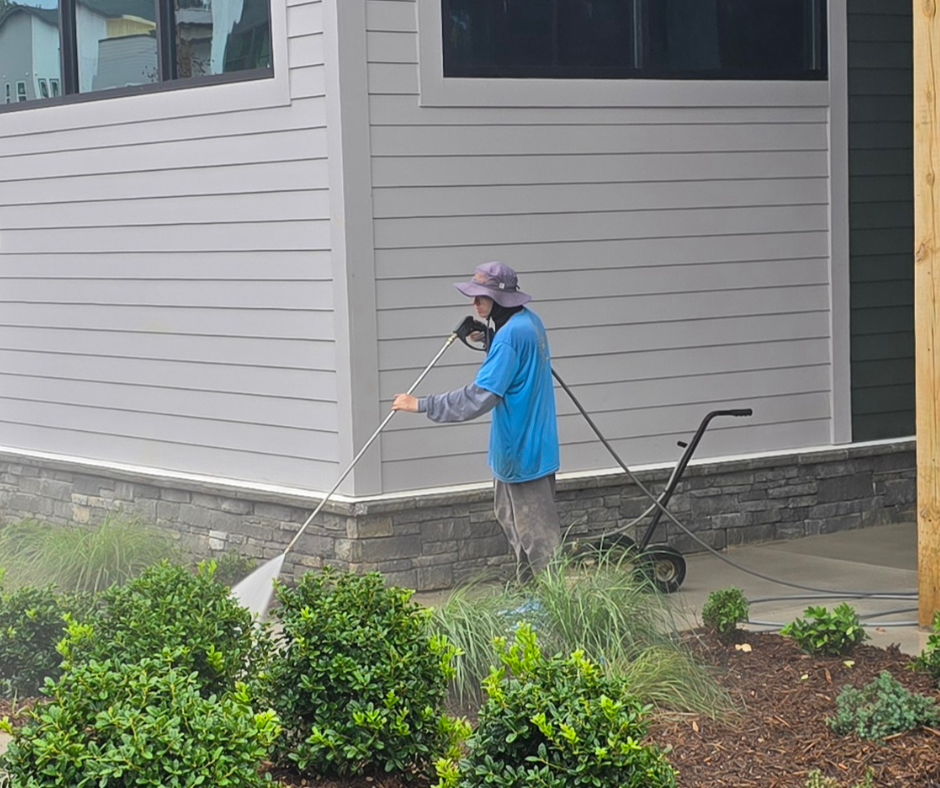
Charlotte has a deep pool of pressure washing vendors. Only a fraction of them have the equipment, the crew size, the insurance posture, and the documentation discipline to handle a 200-unit community on a recurring schedule. The differences are not subtle once you know what to look for.
 
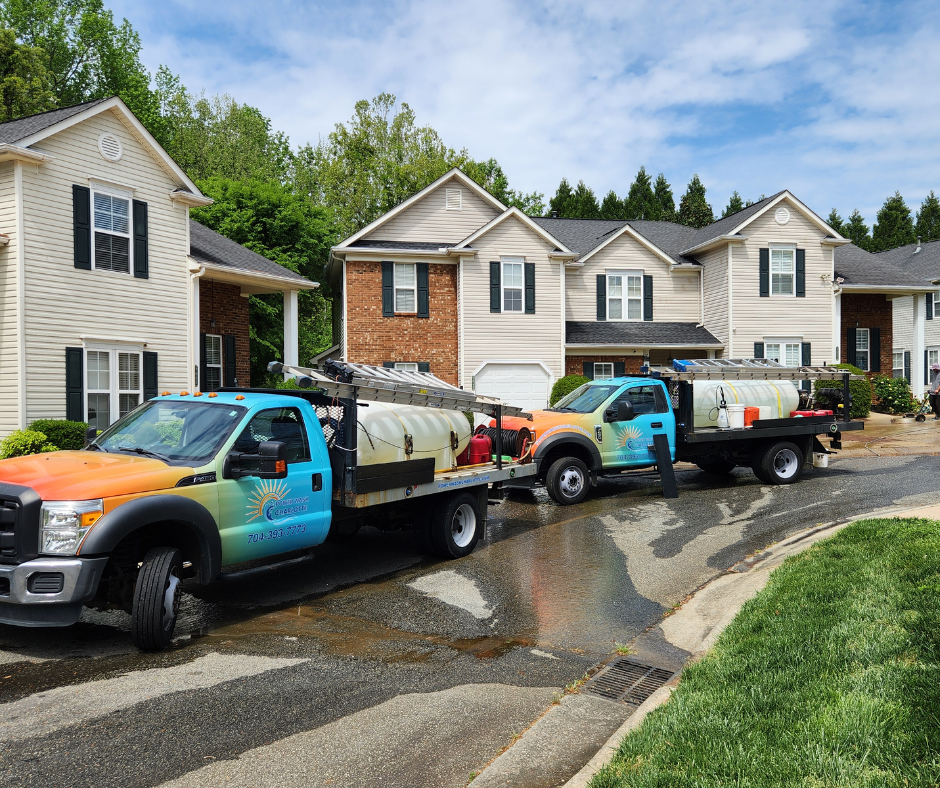
A real multi-family vendor brings a crew, not a single technician, and their company vehicles are marked and matched. Their equipment is hot-water capable for dumpster pads and grease lines. Their soft wash setup is separate from their pressure washing setup, because the cleaning agent ratios and pressures are different. They produce documentation without being asked, including before and after photos, signed walk-throughs, SDS sheets for the cleaning agents in use, and proof of stormwater containment when the job warrants it. They answer the phone during business hours and confirm appointments the day before.
 
A one-truck operator, by contrast, tends to show up alone in an unmarked vehicle, quotes the job over the phone without a walk, uses one machine for every surface regardless of method, has a COI that names the wrong entity or no entity at all, and disappears for two weeks between contact attempts. Several of the worst multi-family complaints we have seen at communities we later took over started with a quote that was 40 percent below the next bid. The bid was low because the scope was missing four surfaces, the COI was missing the additional insured endorsement, and the crew never finished the job.
PWC - Commercial Services - Common Ground Cleaning

How much does multi-family pressure washing in Charlotte cost?

Pricing depends on building count, surface mix, and frequency. The ranges below reflect typical 2026 multi-family pricing in the Charlotte metro and should serve as a sanity check on bids you receive, not a fixed quote.
 
ServiceTypical Range (Charlotte Metro)Frequency
Breezeway + stairwell wash, per building, 3 stories$180-$320Quarterly
Dumpster pad surround, per pad$95-$180Monthly recommended
Building soft wash, per garden-style building, 8-12 units$450-$850Annual
Sidewalk + entry walk, per 1,000 linear feet$220-$380Biannual
Parking lot oil drip line cleaning$0.04-$0.08 per sq ftAnnual
Signage cleaning, monument + building blade signs$80-$240 per signBiannual
Pool deck pressure wash$0.10-$0.18 per sq ftPre-season

Bundle pricing for an annual maintenance contract usually lands 15 to 25 percent below the sum of one-time line items, because the vendor can plan crew loading and equipment moves across the year. Power Wash Charlotte gives a fair price upfront with no hidden fees, and our quotes for multi-family properties are typically delivered same-day after a walk-through.Bundle pricing for an annual maintenance contract usually lands 15 to 25 percent below the sum of one-time line items, because the vendor can plan crew loading and equipment moves across the year. Power Wash Charlotte gives a fair price upfront with no hidden fees, and our quotes for multi-family properties are typically delivered same-day after a walk-through.

Frequently Asked Questions About Apartment Pressure Washing in Charlotte

How often should a Charlotte apartment community schedule exterior cleaning?
 
Most 150- to 300-unit garden-style communities in Charlotte should be on at least an annual building soft wash, quarterly breezeway and stairwell wash, and monthly dumpster pad cleaning. Class A communities and properties in highly visible corridors such as SouthPark, Ballantyne, and South End usually move to quarterly building washes and biweekly pad cleaning to protect online reputation and audit scores.
 
Does pressure washing damage vinyl siding or apartment building exteriors?
 
It can if the wrong method is used. Vinyl, fiber cement, and aged brick on most Charlotte apartment buildings require a low-pressure soft wash with specialized cleaning agents, not direct high-pressure water. A vendor who uses the same machine and the same pressure on every surface is the most common cause of damaged siding panels, stripped paint, and forced water intrusion behind brick veneer.
 
What insurance limits should a multi-family pressure washing vendor carry in Charlotte?
 
The baseline is $1 million per occurrence and $2 million aggregate on commercial general liability, statutory workers’ compensation, and $1 million combined single limit on commercial auto if any vehicles enter the property. Class A communities and national property management companies typically require $2 million per occurrence and a $5 million umbrella. The vendor’s COI must name the property management company and the ownership entity as additional insured on both an ongoing and completed operations basis.
 
Are pressure washing vendors required to follow Charlotte-Mecklenburg stormwater rules?
 
Yes. Pressure washing wash water is a regulated discharge under Charlotte-Mecklenburg Storm Water Services rules, and the property owner is the party named on any Notice of Violation. The vendor should carry containment equipment for dumpster pads and parking areas, follow the city’s published acceptable disposal practices, and indemnify the property in writing.
 
Can pressure washing be scheduled after hours to avoid resident disruption?
 
It can, and for parking lots, pool decks, and exterior common areas it is often the best choice. After-hours work usually costs 15 to 25 percent more and requires written approval from the property and clear coordination with the on-site team. Breezeways and stairwells are generally cleaner-result and safer to schedule on weekdays with 48-hour written notice posted to affected residents.
 
What is the difference between pressure washing and soft washing for an apartment building?
 
Soft washing is a low-pressure cleaning method that uses specialized cleaning agents to safely remove algae, mildew, and dirt from siding, roofs, and other delicate surfaces. Pressure washing uses higher-pressure water and is appropriate for concrete, parking lots, and dumpster pads. A multi-family scope of work should specify which method is used on which surface, because the wrong method on the wrong surface is the single largest source of vendor-caused damage claims.
 
Need a quote for your home or property? Call Chris and the Power Wash Charlotte team at (704) 393-7773 or get your free quote.
By Chris Earll, Owner of Power Wash Charlotte
 
Chris Earll is the owner of Power Wash Charlotte (Cutting Edge Restoration Inc), serving the Charlotte metro since 1996. He and his team have completed thousands of residential and commercial pressure washing projects across Mecklenburg, Union, Cabarrus, Iredell, Gaston, Lancaster, and York counties.
Chris Earll President - Sales and Marketing
Share