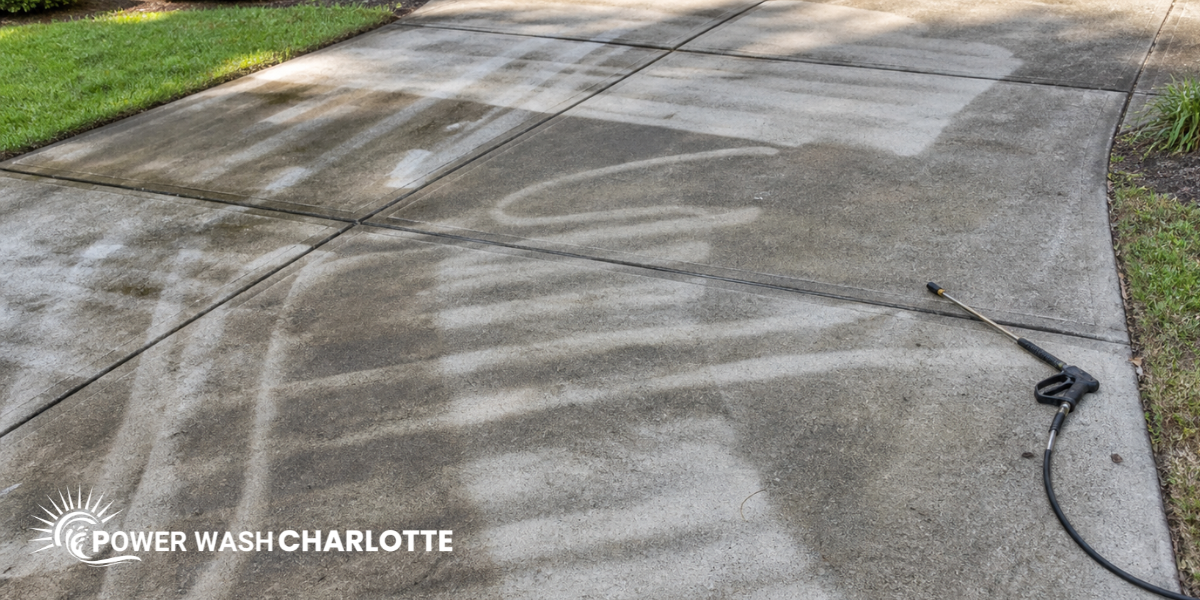
DIY pressure washing damage in Charlotte means cracked vinyl panels, stripped paint from brick and mortar, voided roof warranties, and mildew that comes back within weeks because water pressure alone never kills algae. The seven most common mistakes come down to too much PSI on the wrong surface, the wrong nozzle distance, and skipping the cleaning agents that do the actual work.
With nearly 30 years cleaning homes and businesses across Mecklenburg, Union, Cabarrus, and York counties, Power Wash Charlotte has assessed, re-cleaned, and worked around more DIY pressure washing mistakes than we can count.
Every spring, starting around the second week of April when the pollen film is at its worst, the same pattern plays out across Plaza Midwood, Dilworth, and the older subdivisions south of Uptown. A homeowner rents a pressure washer, points it at the siding, and starts spraying. Nothing obviously wrong happens in the moment. The damage shows up a week later: a cratered vinyl panel, a window that has gone foggy, a wall with white paint stripped down to gray primer. Or it shows up in August, when the mildew is back and worse than before, because water pressure did nothing to the root of the problem.
Here is what each of the seven mistakes looks like, and what each one costs to fix.
What Does DIY Pressure Washing Damage Actually Look Like on a Charlotte Home?
DIY pressure washing damage falls into three categories: cosmetic damage to the surface, structural damage behind the surface, and cleaning failure.
Cosmetic damage is the most visible. Cracked or dented vinyl panels, stripped paint on old painted brick, mortar joints eroded down to the brick face, wood grain raised and splintered from over-pressure. These show up within days or weeks.
Structural damage is quieter. Water driven behind siding channels at the wrong angle saturates wall sheathing and framing before anything visible appears outside. In Charlotte’s humid subtropical climate, where summer relative humidity routinely hits 70 percent and evening dewpoints stay above 65 degrees from June through September, a hidden wet cavity can become a mold cavity in weeks.
Cleaning failure looks like a clean house in June that is green again by late July. Pressure strips the visible layer of algae from siding but leaves the root colony alive inside the surface pores. With Charlotte’s overnight moisture levels, that colony regrows as fast as it grew the first time.
DIY pressure washing damage is the category of harm caused by applying residential water pressure equipment to surfaces or problems that require a lower-pressure method, a detergent pre-treatment, or both.
Soft washing is a low-pressure cleaning method that uses a sodium hypochlorite cleaning agent to kill algae, mildew, and cyanobacteria at the root, rather than dislodging them from the surface with force.
Why Does Too Much Pressure Ruin Vinyl Siding and Fiber Cement Panels?
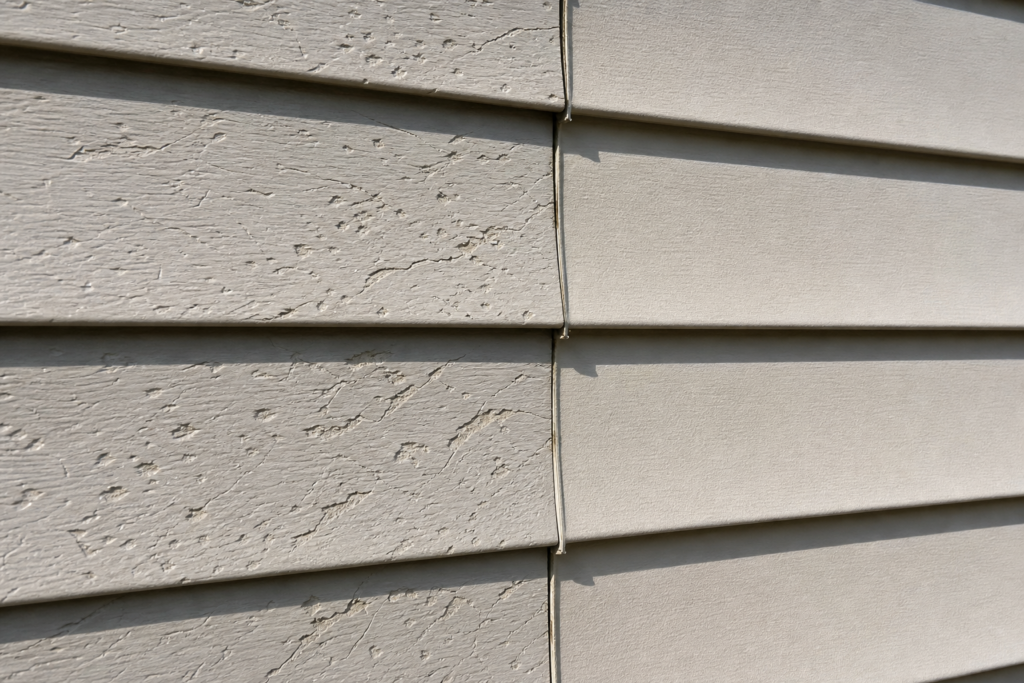
Vinyl siding is not hard. It flexes, which makes it a durable cladding in Charlotte’s freeze-thaw climate, but that same flexibility means a high-pressure stream can dent, crack, or warp a panel it hits directly. The damage threshold starts at roughly 1,800 to 2,000 PSI at close range, and most residential rental machines run at or above that level by default.
Mistake #1: Wrong PSI for the surface.
Pointing a 3,100 PSI machine at vinyl siding with a standard 25-degree tip does not clean the surface; it batters it. The factory texture on a vinyl panel is thin. A concentrated stream crazes the surface and permanently weakens the panel at the contact point.
Mistake #2: Nozzle too close to the surface.
The PSI rating on a machine’s label is measured at the pump. At 24 inches from a surface, a 2,500 PSI machine delivers roughly 1,200 to 1,400 effective PSI, which is safe for most sidings. At 6 inches, the same machine delivers close to the full rated pressure in a tight stream. Most first-time users hold the wand far closer than they should when working on a stubborn stain.
Fiber cement (Hardie board) is harder but porous. James Hardie’s care and maintenance guidelines recommend a maximum of 1,500 PSI for cleaning HardiePlank, directed at a downward angle to avoid driving water behind the boards. Most rental machines exceed that at factory settings.
Mistake #4 (related): Driving water behind siding.
Spraying upward at panel channels or at a gap between panels forces water behind the cladding. In a typical wood-framed Charlotte home, that water contacts the housewrap, then the sheathing, then the framing if the housewrap is aging or compromised. Water infiltration behind vinyl, left undetected, leads to wall-cavity mold and rot that costs $2,500 to $15,000 or more to remediate and repair.
Cost for Mistakes #1 and #2:
A cracked or scored vinyl panel section costs $4 to $10 per square foot installed in Charlotte. A single wall section that gets cratered runs $800 to $3,000 or more to replace.
What Happens When You Point a Pressure Washer at a Charlotte Roof?
This is the most expensive mistake on the list.
Asphalt shingles are built from a fiberglass mat, an asphalt coating, and a surface layer of mineral granules. Those granules protect the asphalt from UV degradation and are bonded to the asphalt by a water-resistant bond, not a pressure-resistant one.
Mistake #3: Pressure washing asphalt shingles.
A residential pressure washer running at 2,000 PSI strips granules off asphalt shingles on contact. Once the granule layer is gone, the asphalt oxidizes under the UV load and the shingle fails years ahead of its rated life. The Asphalt Roofing Manufacturers Association explicitly prohibits high-pressure washing of asphalt shingles in its maintenance guidance, and GAF and Owens Corning both state that pressure washing voids their respective shingle warranties.
Roof algae, which is the reason most Charlotte homeowners want to wash their roof in the first place, responds to the right cleaning agent. A soft wash using a diluted sodium hypochlorite solution applied at low pressure kills Gloeocapsa magma at the root. The rinse removes the dead material with no granule loss. That result lasts 12 to 24 months. A pressure-only approach strips the visible dark layer and leaves the living colony behind in the shingle pores, where it regrows.
Cost for Mistake #3:
A partial patch replacement from granule loss runs $300 to $600 per square (a 10 by 10 foot section). A premature full roof replacement triggered by pressure-stripped shingles runs $8,000 to $25,000 for a typical Charlotte residential roof.
How Do You Accidentally Strip Paint from Brick, Mortar, and Stucco?
Charlotte’s older neighborhoods, Dilworth, Eastover, Sedgefield, and historic Madison Park, include a large proportion of painted brick and hard-coat stucco homes. These surfaces look durable. Many are. The mortar joints between old brick are not.
Mistake #5: Direct pressure on old painted brick or mortar joints.
Old brick mortar in a pre-1960s Charlotte home is often lime-based. Lime mortar is soft by design; it was built to be the sacrificial element in the wall assembly, giving way before the brick face cracks. A 2,000 PSI stream directed at a lime mortar joint erodes it on contact. Loose mortar is cosmetically minor until water enters the joint in a freeze-thaw cycle and spalls the brick face from behind.
Painted exteriors carry the same vulnerability at the paint-film level. If the adhesion point in exterior latex over old painted brick is weak, a high-pressure stream lifts the edge of the paint film and pulls. Stucco has a thin skim coat layer that chips and fractures under direct pressure if any underlying micro-cracking exists. Both of these failures are common in the older brick homes along the tree-canopy streets of Eastover and Dilworth.
For more on what professional pressure washing actually looks like on these surfaces, our earlier post on why hiring a pressure washing expert in Charlotte saves time and money covers the broader decision.
Cost for Mistake #5:
Repointing damaged mortar runs $8 to $20 per square foot in Charlotte. A single exterior wall section runs $3,000 to $10,000 or more. Exterior repainting of a painted-brick Charlotte home runs $2,000 to $8,500, depending on square footage and the condition of the existing paint film.
Why Are Window Seals and Door Gaskets Vulnerable to a Pressure Washer?
Double-pane windows have two glass panes with a factory-sealed argon or air gap between them. That sealed gap is what gives the window its insulating performance. The perimeter sealant holding the gas in is durable under normal conditions; it is not rated for direct water pressure.
Mistake #6: Directing pressure at windows or door frames.
A pressure washer aimed at a window at close range, especially at the corner where the glass meets the frame, can crack or displace the perimeter sealant. Once that seal fails, the gas fill escapes and moisture enters the gap between the panes. The first sign is fogging between the panes. The second sign, often noticed a full heating or cooling season later, is a cold spot or measurable drop in insulation performance.
Door gaskets, the rubber seals running around the perimeter of a door frame, are similarly vulnerable. A direct spray into the gap between a door slab and its casing can displace the gasket from its channel or strip the caulking at the threshold, allowing water infiltration at the sill.
These are quiet failures. Homeowners often do not connect the foggy windows or the drafty door to the pressure washing session until months later.
Cost for Mistake #6:
Replacing the insulated glass unit in a standard double-pane window runs $75 to $225 per window in the Charlotte area. A home with 16 double-pane windows that received a broad misdirected spray could face $1,200 to $3,600 in glass unit replacements.
Why Does Mildew Come Right Back After a DIY Pressure Wash?
Mistake #7: Water only, no cleaning agents.
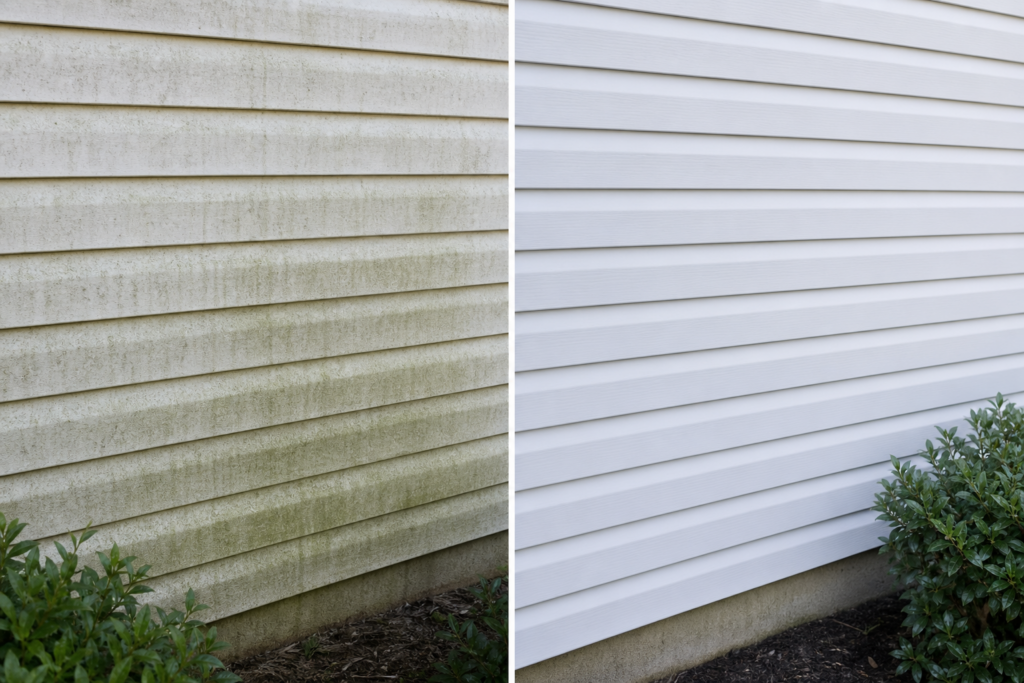
Water pressure moves mildew off a surface. It does not kill it. The algae species that produce green staining on the north-facing siding of Charlotte homes have root structures that penetrate the surface pores of vinyl, painted wood, and fiber cement. A pressure washer clears the visible layer while leaving the colony below alive and intact.
In Charlotte’s climate, with outdoor relative humidity running 70 to 75 percent through late August and dewpoints that keep exterior surfaces damp for eight or more hours each night, a surviving algae colony regrows to visible size within four to eight weeks of a water-only wash.
The correct method is a pre-treatment with a sodium hypochlorite blend applied at the right dilution for the surface, left to dwell long enough to kill the organism at the root, and then rinsed at low pressure. That is what professional soft washing delivers, and it is why a professional result in Charlotte’s climate lasts 12 to 24 months while a pressure-only DIY wash often repeats within the same season.
Gloeocapsa magma is a cyanobacterium that feeds on the limestone filler in asphalt shingles and on organic debris on siding surfaces, producing the black streaks and contributing to the green-black staining visible on Charlotte exteriors each summer.
How Much Does Each DIY Pressure Washing Mistake Cost to Fix?
Here is a summary of all seven mistakes and their typical repair costs in the Charlotte market as of 2026.
| Mistake | Surface or Item Damaged | Typical Repair Cost, Charlotte 2026 |
|---|---|---|
| #1: Too much PSI on vinyl or Hardie | Cracked, dented, or scored panels | $4-$10/sq ft installed; $800-$3,000+ per wall section |
| #2: Nozzle too close | Compounds Mistake #1; same failure mode | Bundled with Mistake #1 repair estimate |
| #3: Pressure washing asphalt shingles | Granule loss, manufacturer warranty voided | $300-$600 per square for patching; $8,000-$25,000 full replacement |
| #4: Water driven behind siding | Wall cavity mold or rot | $2,500-$15,000+ for mold remediation and drywall repair |
| #5: Stripping paint or mortar | Painted brick, stucco skim coat, or lime mortar joints | $2,000-$8,500 exterior repaint; $8-$20/sq ft mortar repointing |
| #6: Cracking window seals | Fogged insulated glass units | $75-$225 per window |
| #7: No cleaning agents, mildew returns | Re-cleaning required within 4-8 weeks | $200-$500 additional service call |
For comparison: a professional whole-home soft wash in Charlotte typically runs $250 to $600 for a single-story home and $400 to $850 for a two-story, with pre-treatment, a post-job walkthrough, and a fully insured crew. None of the repair estimates above are worst-case outliers. They reflect the standard middle-range quotes from Charlotte contractors and suppliers as of 2026.
Frequently Asked Questions About DIY Pressure Washing Damage in Charlotte NC
Is it safe to DIY pressure wash any part of my Charlotte home?
Flat, low-risk surfaces like concrete patios, brick pavers, and plain driveways are manageable for a careful DIYer using a 25-degree or 40-degree tip at 18 to 24 inches from the surface. Siding, roofs, older painted surfaces, and any wood-framed structure carry significantly higher damage risk. If the surface is vertical, older than 20 years, painted, or made of wood or fiber cement, professional soft washing is the lower-risk and lower-lifetime-cost choice for a Charlotte home.
How do I know if I already damaged my siding with a pressure washer?
Look for hairline cracks along the face of vinyl panels, sections where the surface texture has gone flat or slightly concave, or panels that flex unusually when you press against them. Water infiltration behind the cladding is harder to detect from the outside. Soft spots on interior walls, moisture odors near baseboard level, or increased air movement around outlet covers after a DIY wash are all signs worth having a contractor assess before assuming the wall cavity is dry.
Will my North Carolina homeowner’s insurance cover DIY pressure washing damage?
Most standard NC homeowner’s policies cover sudden accidental damage but specifically exclude damage caused by improper maintenance or owner error. Granule stripping from a roof you pressure-washed yourself is likely to be categorized as owner-caused wear, not an insured peril. The same classification typically applies to mortar erosion, paint stripping, and vinyl panel cracking. Review your specific policy language with your carrier before assuming any of the repair categories above would be covered.
How much does professional pressure washing cost compared to renting a machine myself?
A daily rental from a Charlotte-area hardware store runs $75 to $140 for the machine, plus cleaning agents and your own labor time. A professional whole-home soft wash runs $250 to $850, fully insured, with a pre- and post-job walkthrough from a trained crew. When you weigh the daily rental cost against the repair table above, the professional service pays for itself on any surface other than flat concrete.
Can Power Wash Charlotte help with a home that was already DIY pressure washed?
Yes. Our team assesses the condition of all exterior surfaces during every quote visit and will give you an honest evaluation of what you are working with before any cleaning work is scheduled. Call us at (704) 393-7773 or get your free quote.
Need a quote for your home or property? Call Chris and the Power Wash Charlotte team at (704) 393-7773 or get your free quote.
By Chris Earll, Owner of Power Wash Charlotte
Chris Earll is the owner of Power Wash Charlotte (Cutting Edge Restoration Inc), serving the Charlotte metro since 1996. He and his team have completed thousands of residential and commercial pressure washing projects across Mecklenburg, Union, Cabarrus, Iredell, Gaston, Lancaster, and York counties.