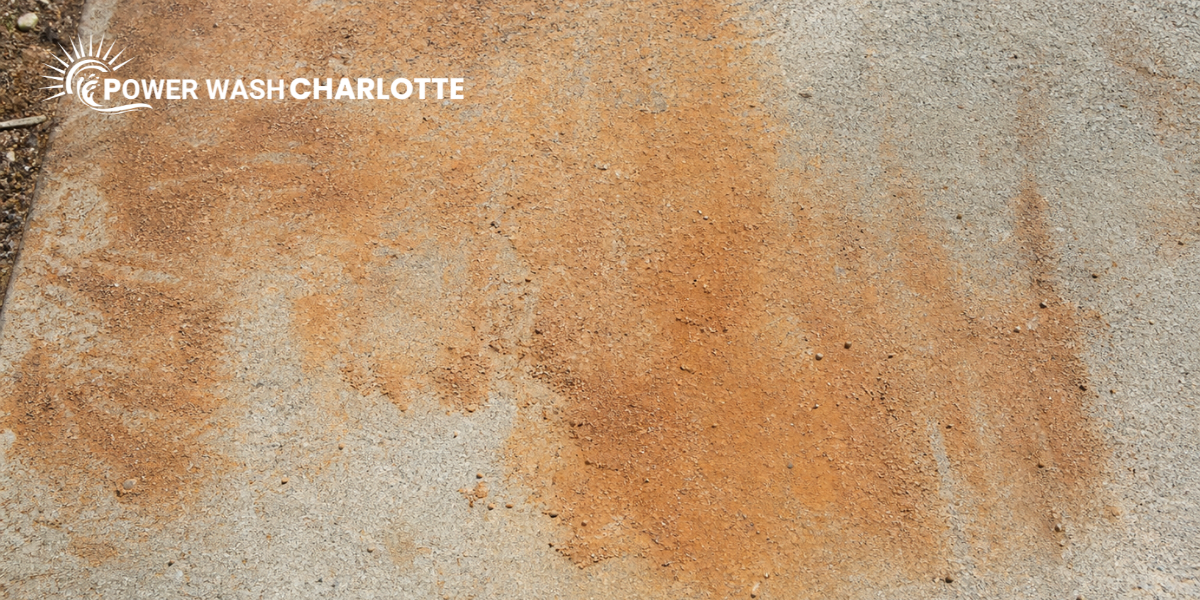
Red clay stains on a Charlotte driveway are iron-oxide particles from the region’s Cecil soil that have bonded into the porous surface of concrete. Plain water and standard pressure washing rarely remove them because iron oxide is not water-soluble. The fix is a controlled acid treatment that converts iron oxide into a water-soluble salt, followed by a neutralized rinse.
With nearly 30 years cleaning homes and businesses across Mecklenburg, Union, Cabarrus, and York counties, Power Wash Charlotte has been called out to thousands of driveways stained by the same red clay that gives the Piedmont its color. The same clay that the North Carolina legislature named the state soil in 1990 is the clay that is staining your driveway, and the chemistry behind why it sticks is also the chemistry behind why pressure alone fails to remove it.
Have you ever pressure washed your Charlotte driveway, watched the rust-orange streaks go faint for an hour, and then watched them come right back as the concrete dried? That is not a flaw in the pressure washer. It is the chemistry of red clay. This guide explains what the stains actually are, where they come from, why ordinary cleaning methods fail, what actually removes them, and how to keep them from returning.
What are red clay stains, and why is the Charlotte version so stubborn?
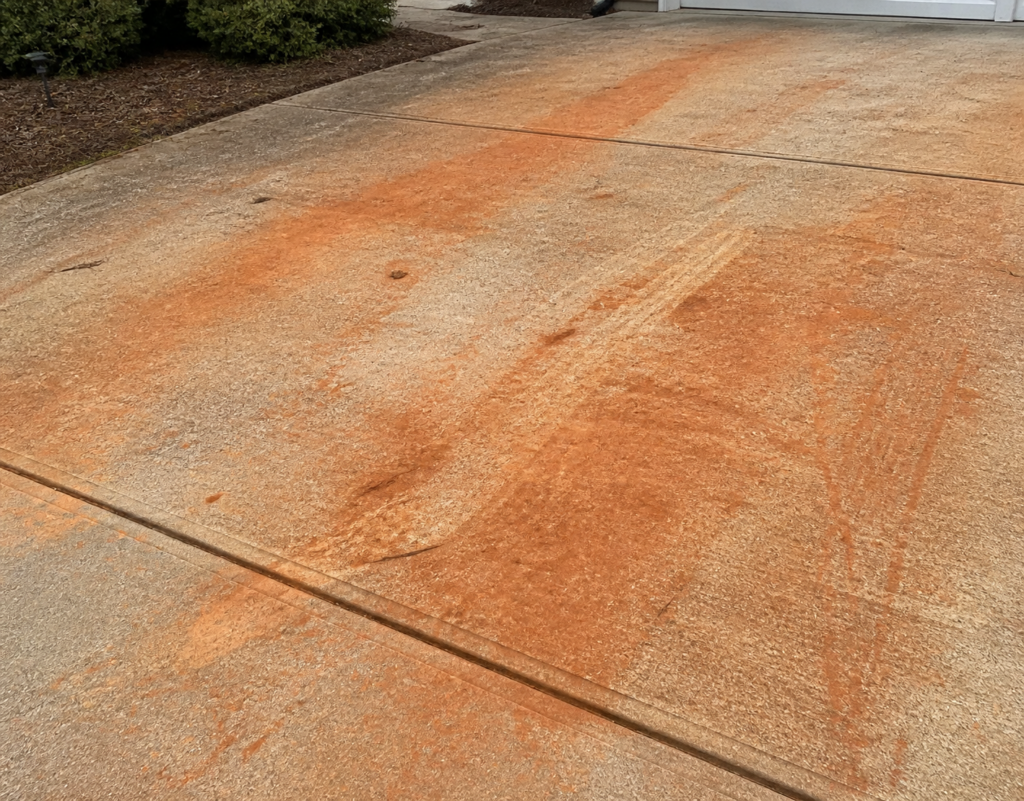
Red clay staining is the orange-brown discoloration caused by iron oxide bound to kaolinite clay particles, common across the Piedmont and especially concentrated in Mecklenburg, Union, and Cabarrus counties. The color comes from the same chemistry that turns iron into rust. The USDA Official Series Description for Cecil soil, the dominant soil series under most Charlotte-area driveways, describes a subsoil dominated by kaolinite clay carrying significant iron oxides. That iron content is what gives the soil its color, and it is what turns into a permanent-looking stain on concrete.
Concrete is porous at the microscopic level. When red clay slurry from rain runoff, irrigation overspray, or construction tracking touches a concrete driveway, the iron-rich clay particles work their way into those pores. Once they are inside the surface, a pressure washer can blast off the surface dirt all day without lifting them. The water just hits the concrete, slides off, and leaves the embedded iron behind.
Where does the red clay on your Charlotte driveway actually come from?
Most Charlotte-area driveways did not stain themselves overnight. The clay arrived from a specific source, and identifying that source matters because the same source will keep depositing more clay until it is addressed.
The four most common red clay sources we find on Charlotte driveways are heavy rain washing exposed dirt onto concrete, construction activity next door tracking clay across the driveway on truck tires, irrigation overspray hitting flower beds and carrying clay onto the slab, and grading work on the lot itself within the last two or three years. Newer subdivisions in Waxhaw, Indian Trail, Mint Hill, Marvin, and the Concord and Kannapolis I-85 corridor see the worst of it because grading is recent, mulch beds are still settling, and surrounding lots may still be raw dirt.
A driveway that has been stable for ten years can pick up clay in a single afternoon if a neighbor breaks ground on a new build. We see this constantly across Union and Cabarrus counties during the spring building season.
Why doesn’t a garden hose or a basic pressure washer remove red clay?
The short answer is that iron oxide does not dissolve in water. The longer answer is what most homeowners learn the hard way.
A garden hose moves the loose clay particles around but cannot reach into the pores of the concrete where the iron has settled. A consumer-grade pressure washer, even one rated at 3,000 PSI, hits the same wall. Pressure removes surface dirt, surface grease, and surface algae. It does not break a chemical bond. The iron oxide particles in red clay are bound at the molecular level to the calcium and silicate matrix of cured concrete, and no amount of water pressure changes that.
There is a second problem. High-pressure water on residential concrete is one of the easier ways to etch the surface. Many of the Charlotte driveways we see have a haze pattern from where a homeowner held a turbo nozzle too long, trying harder and harder to lift a clay stain that pressure cannot lift. The driveway ends up with both the original red clay still in place and new pressure-wash etching scars layered on top. Our team handles enough of these remediation jobs that we wrote about the larger pattern on the DIY pressure washing gone wrong page on the main site.
What chemistry actually removes red clay stains from Charlotte concrete?
The cleaner that works on red clay is a rust remover, because red clay staining is functionally a rust stain. The active ingredient in most professional rust removers is oxalic acid, a mild organic acid that reacts with iron oxide to form iron oxalate, which is water-soluble. As Concrete Network’s technical guide on removing rust stains from concrete describes, oxalic-acid-based cleaners are the standard professional approach for iron and rust staining on concrete.
| Stain Source | Cleaning Agent Type | Why It Works |
|---|---|---|
| Red clay, iron oxide bound to kaolinite | Oxalic-acid rust remover | Converts iron oxide to water-soluble iron oxalate |
| Surface dirt and pollen | Surface cleaner + pressure washing | Mechanical removal of loose particles |
| Algae and mildew | Sodium-hypochlorite-based detergent | Kills and breaks down organic growth |
| Oil and tire rubber | Alkaline degreaser | Lifts hydrocarbons from concrete pores |
The chemistry sounds simple, and at the lab bench it is. The execution is where most DIY attempts fail. Oxalic acid is corrosive to skin, eyes, and lungs, etches the wrong concrete finishes if the dwell time is wrong, and kills landscaping if it runs off untreated. Professional crews apply the cleaner at a controlled concentration, monitor dwell time on the surface, agitate with a soft brush, rinse with hot water, neutralize the runoff, and recover wash water rather than send it into storm drains. That is also why oxalic acid alone, poured from a hardware-store jug onto a driveway, often makes the stain worse before it makes it better.
When should you call a professional for red clay stains in Charlotte?
There are situations where a careful homeowner can knock down a small fresh stain with a rust-remover product from a hardware store. There are more situations where the right answer is to call a professional, and the cost of the mistake is higher than the cost of the service.
The four scenarios where professional cleaning pays for itself are large or driveway-wide staining, staining on stamped or decorative concrete, staining near a flower bed or sensitive landscaping, and staining tied to an active construction source next door. Stamped concrete is especially unforgiving because the sealer reacts differently to oxalic acid than bare concrete, and a streak pattern from a botched DIY treatment becomes permanent.
How can you prevent red clay stains from coming back?
Even a perfect cleaning fails if the clay source is still active. Prevention is half the job, and most of it does not require any special equipment.
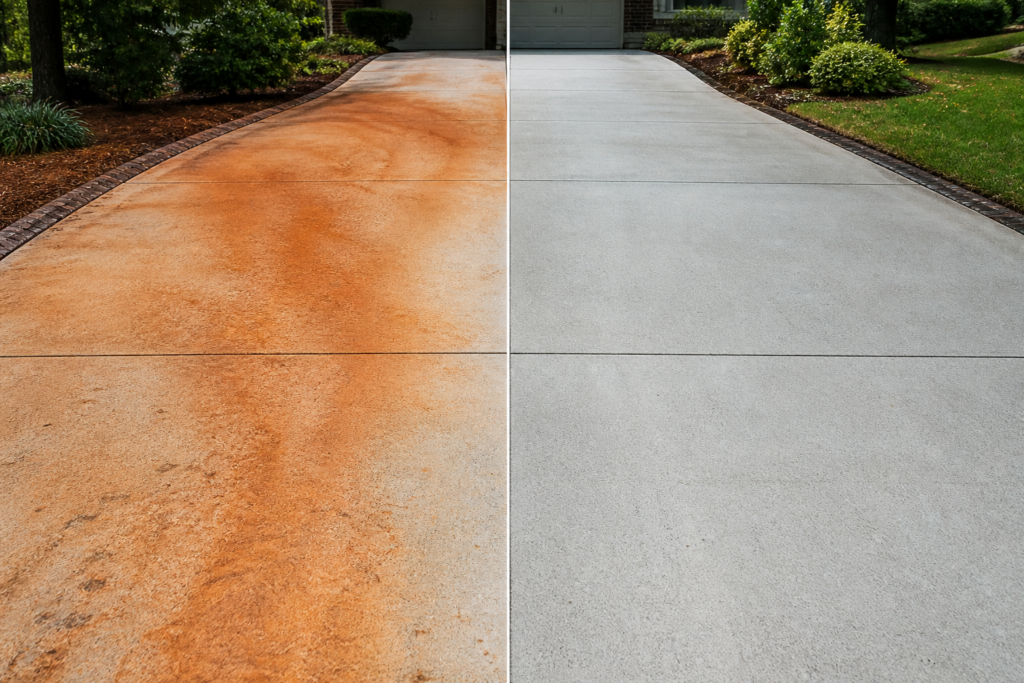
Five steps make a meaningful difference. First, redirect downspouts away from concrete edges so that roof runoff does not carry clay onto the driveway. Second, mulch or plant exposed dirt areas adjacent to the driveway, especially on the uphill side. Third, adjust irrigation heads so that spray does not hit flower beds in a way that creates clay runoff. Fourth, ask any neighboring contractor running heavy equipment in the neighborhood to power-wash their tires before crossing your driveway. Fifth, seal the driveway with a penetrating concrete sealer after the cleaning is complete. A sealed driveway gives clay nothing to bond to, and a rinse with a garden hose will clear most fresh deposits.
Sealing is the single highest-value step for new Charlotte construction. Driveways in Highland Creek, Christenbury, Bonterra, Marvin Creek, and the Skybrook and Birkdale neighborhoods all benefit from a sealer pass after the first professional cleaning, because the surrounding lots are still actively shedding clay for the first two to three years after build-out.
How much does professional red clay stain removal in Charlotte cost?
Pricing depends on driveway size, severity of the staining, and whether the surface is bare or sealed. The ranges below reflect typical 2026 Charlotte-metro pricing and should serve as a sanity check on quotes you receive.
| Service | Typical Range (Charlotte Metro) | Notes |
|---|---|---|
| Single-car driveway red clay treatment | $185-$320 | Spot treatment of localized staining |
| Two-car driveway full red clay treatment | $325-$525 | Includes pre-rinse, treatment, scrub, and neutralized rinse |
| Three-car driveway or extended apron | $475-$725 | Includes garage apron and sidewalk approach |
| Stamped or decorative concrete add-on | +$120-$240 | Slower dwell, gentler agitation, sealer test |
| Penetrating concrete sealer, post-clean | $0.45-$0.85 per sq ft | Recommended after first cleaning for new builds |
Power Wash Charlotte gives a fair price upfront with no hidden fees. Quotes are typically delivered the same day after the team walks the driveway with the homeowner and identifies any active clay source that needs to be addressed first.
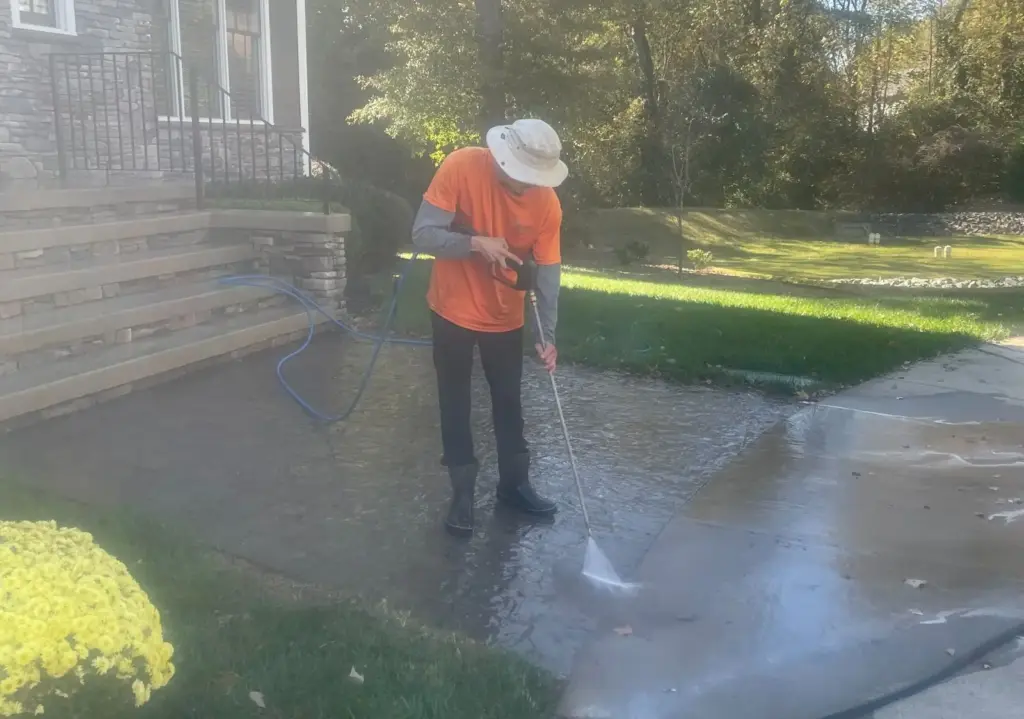
Frequently Asked Questions About Red Clay Driveway Stains in Charlotte
Can a regular pressure washer remove red clay stains from concrete?
A regular pressure washer can remove fresh, loose surface clay, but it cannot remove embedded iron-oxide staining because pressure does not break the chemical bond between iron oxide and the concrete pore structure. The result of pressure-only treatment is usually a slightly lighter stain that returns within hours of the surface drying. Professional red clay removal uses an oxalic-acid rust remover before pressure washing, not pressure alone.
Is oxalic acid safe to use on a Charlotte driveway?
Oxalic acid is effective on iron-based stains but is corrosive to skin, eyes, and respiratory tissue, etches some concrete finishes if dwell time is wrong, and damages landscaping if rinsed without containment. Professional crews use it routinely with the right protective equipment, controlled concentration, and wash-water management. We do not recommend untrained homeowners apply concentrated oxalic acid on stamped concrete, near flower beds, or on driveways that drain directly to a storm drain.
Will red clay stains come back after professional removal?
They will not return from the same event, but new clay deposits from new sources will create new stains. The most common return mechanisms are continued construction activity nearby, untreated downspout discharge, irrigation overspray on flower beds adjacent to concrete, and untreated raw dirt on the uphill side of the driveway. A penetrating sealer applied after cleaning dramatically slows the reappearance of staining.
Why is the red clay problem worse in Charlotte than in other Southern cities?
Charlotte and the surrounding Piedmont sit on the Cecil soil series, which the USDA describes as a kaolinite-dominated red clay carrying significant iron oxide. That specific combination of fine clay particles and high iron content is what makes Piedmont red clay both intensely colored and unusually persistent on concrete. Coastal-plain soils in Eastern North Carolina and most of South Carolina contain less iron oxide and stain concrete far less aggressively.
How long does professional red clay removal take?
A typical two-car residential driveway in Charlotte takes between 90 minutes and three hours of on-site time, depending on staining severity. The chemistry needs dwell time on the concrete before agitation and rinsing, so the technician is not actively scrubbing for the entire window. Add another 45 to 90 minutes if a penetrating sealer is applied after cleaning.
Are there areas of Charlotte where red clay staining is more common?
Yes. Red clay staining is most concentrated in Union County (Waxhaw, Indian Trail, Marvin, Mineral Springs), the eastern Mecklenburg corridor (Mint Hill, Matthews), and the Cabarrus County I-85 corridor (Concord, Kannapolis, Harrisburg). These areas combine Cecil-series subsoil with the highest concentration of new residential construction in the Charlotte metro, which keeps fresh clay in circulation across driveways, sidewalks, and brick mortar joints.
Need a quote for your home or property? Call Chris and the Power Wash Charlotte team at (704) 393-7773 or get your free quote.
By Chris Earll, Owner of Power Wash Charlotte
Chris Earll is the owner of Power Wash Charlotte (Cutting Edge Restoration Inc), serving the Charlotte metro since 1996. He and his team have completed thousands of residential and commercial pressure washing projects across Mecklenburg, Union, Cabarrus, Iredell, Gaston, Lancaster, and York counties.