Restaurant dumpster pad cleaning is the routine pressure washing of the concrete pad and surrounding area beneath your dumpster to lift out grease, food residue, and odor before they trigger health-code citations or pest complaints. Most Charlotte restaurants schedule it monthly between April and October, then bump to quarterly through the cooler months.
Serving the Charlotte metro since 1996, Power Wash Charlotte has built a reputation on doing the job right the first time. Our team has cleaned dumpster pads behind restaurants in NoDa, South End, Plaza Midwood, and across the Mecklenburg County dining corridor for nearly three decades, and the pattern is always the same: the operators who put the pad on a calendar are the same operators who breeze through inspection day.
The Mecklenburg County Food and Facilities Sanitation program permits more than 4,400 food service facilities and conducts more than 13,000 inspections every year. That is not a small number, and the exterior of your building, especially the dumpster pad, is one of the first things an inspector takes in when they walk up. A clean pad does not guarantee a perfect score. A dirty one almost guarantees a writeup.
What is a Dumpster Pad and Why Does It Get So Dirty So Fast?
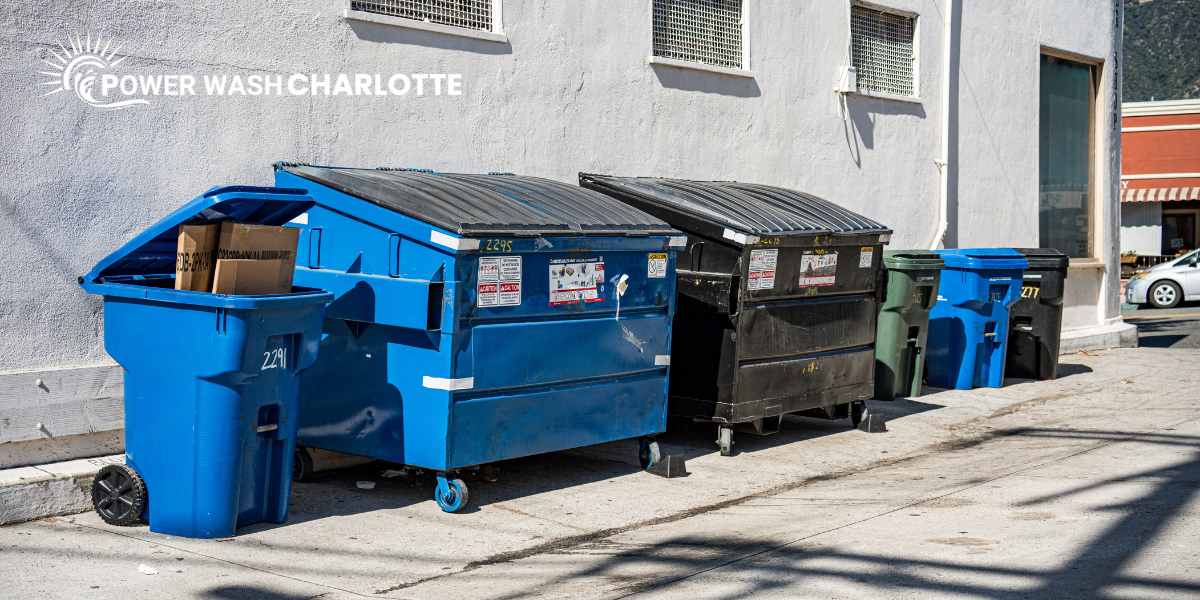
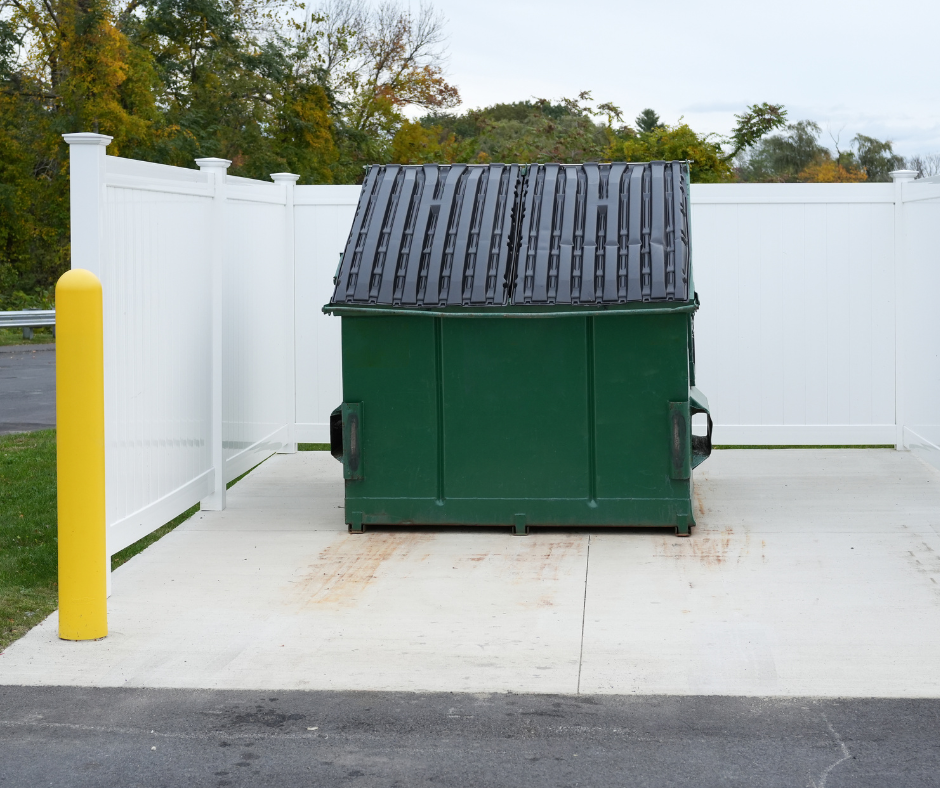
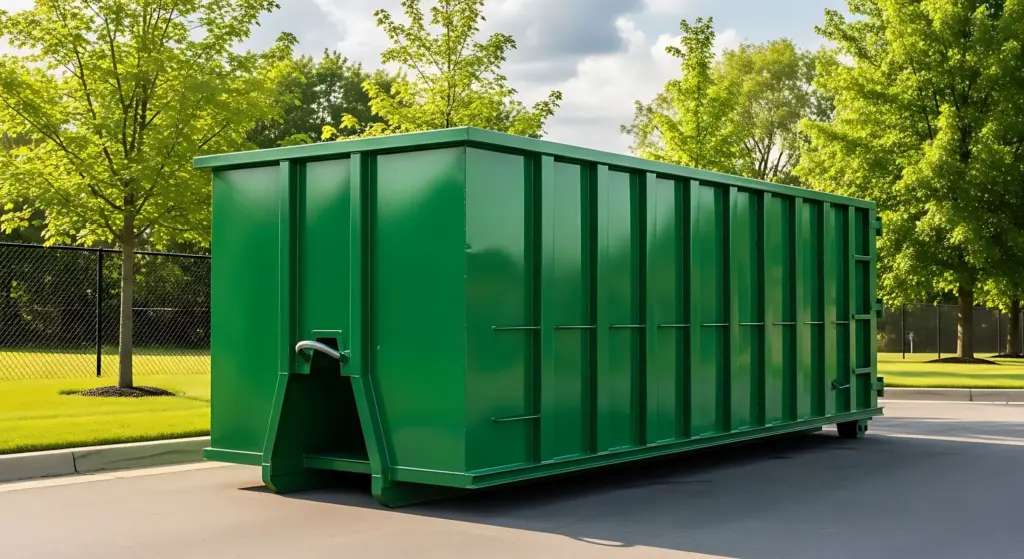
A dumpster pad is the concrete slab a commercial trash container sits on, usually six to twelve feet square, often enclosed on three sides by a screen wall, gate, or block surround. In Charlotte, most restaurant dumpster pads sit at the back of the building near the kitchen exit, the grease bin, and the rear delivery door.
The pad gets dirty fast because almost everything bad in a restaurant’s back-of-house life passes over it. Bag drips from kitchen trash. Spills out of the grease bin. Drippings from boxes of seafood, dairy, and produce on their way to the cooler. Stormwater that runs through the enclosure and pushes residue into the corners. Then sun, heat, and bacteria turn that mixture into the smell every restaurant owner recognizes the moment they open the back door in July.
Three things make Charlotte’s pads worse than average. First, the humidity. Summer dewpoints in the 65 to 72 range keep the pad damp overnight, which lets organic residue ferment instead of dry. Second, the rain. Charlotte averages about 43 inches a year, and most of it falls in short, heavy bursts that flush food residue under the dumpster and into pad cracks where a hose cannot reach. Third, the pests. Mecklenburg County mosquito complaints jumped 52 percent year-over-year in summer 2025, and the same conditions that breed mosquitoes draw flies, roaches, and rodents to a damp dumpster pad.
What Does a Mecklenburg County Health Inspector Actually Check at the Dumpster?
North Carolina restaurants are inspected under the North Carolina Food Code, administered locally by Mecklenburg County Environmental Health. The code does not call out “dumpster pad cleanliness” as a single line item, but several closely related rules effectively require you to keep the pad and surrounding area clean.
What inspectors look at in the dumpster area:
- Lids closed and intact, with no visible holes, gaps, or doors propped open
- No overflow trash, loose bags, or boxes outside the container
- The pad surface free of grease accumulation, food residue, and standing leachate
- No pest activity in or around the dumpster enclosure (flies, roaches, rodents, droppings)
- The surrounding area clean enough that drains, hose bibs, and the back of the building are not coated in residue
- Drainage going to a sanitary sewer connection, not the storm drain, where required by Charlotte Water
In practice, the dumpster area is also where a lot of “premises kept clean” type violations get scored. If the pad smells like a dumpster from twenty feet away in March, the inspector is going to start looking harder at everything else.
How Does Charlotte’s FOG Program Affect What We Can Spray Down the Drain?
Charlotte Water operates a Fats, Oils, and Grease (FOG) Control Program under the city’s Sewer Use Ordinance. The program exists because grease is the single biggest cause of sanitary sewer overflows in Charlotte, and the city polices it aggressively.
FOG, short for fats, oils, and grease, is the residue left behind by cooking, food prep, and dishwashing that hardens inside sewer pipes the way cholesterol hardens inside an artery. When a restaurant’s grease control fails, it does not just back up your own kitchen. It can back up your neighbors and trigger a Notice of Violation that starts at $500 and escalates from there.
For dumpster pad cleaning specifically, the practical rule is this: wash water from a pad with grease residue cannot legally drain into a storm drain. It has to go to the sanitary sewer or be contained, captured, and disposed of properly. A garden hose pushed across a pad and out toward the parking lot can technically be a stormwater violation. That is one of the main reasons restaurants hire a commercial vendor instead of asking a porter to do it with a household hose.
A grease pad service is the use of hot water, surface cleaners, and biodegradable degreasers to break the bond between baked-on grease and the concrete, then capture the wastewater so it never reaches a storm drain. Done correctly, it satisfies both the health code and the FOG ordinance in the same visit.
What Surfaces and Equipment Does the Service Actually Cover?
Most operators picture the pad itself and stop there. A real service touches everything in the enclosure, because grease, food residue, and stormwater do not stay neatly inside the rectangle under the dumpster. The dumpster pad service area, as we run it, includes the concrete pad surface, the four to six feet of pavement surrounding it on the outside of the enclosure, the inside and outside faces of the screen wall (block, metal, or wood), the gate and gate hardware, bollards, hose bibs, the slope to the drain, and the dumpster wheels and casters themselves where accessible.
Equipment matters too. Our team uses commercial hot-water pressure equipment with adjustable tips, a flat surface cleaner for even coverage, a foam cannon for degreaser dwell, and wet vacuum recovery for wastewater capture where the site lacks a sanitary connection. That combination is what separates a real grease pad service from a porter with a kitchen hose.
How Often Should a Charlotte Restaurant Clean Its Dumpster Pad?
Frequency depends on cuisine, volume, and the season. A coffee shop dumping mostly cardboard and milk cartons does not need the same schedule as a barbecue spot dumping bones, fat trim, and pickle brine every night.
The schedule below is what we recommend most Charlotte restaurants run, after almost 30 years of seeing what works and what gets flagged.
| Restaurant Type | Apr–Oct (Hot Season) | Nov–Mar (Cool Season) |
|---|---|---|
| QSR, fast casual, or chain | Monthly | Quarterly |
| Full-service, high-volume restaurant | Every two weeks to monthly | Monthly |
| Coffee shop, bakery, or light-prep restaurant | Quarterly | Twice per season |
| Bar or late-night venue with heavy bottle waste | Monthly | Quarterly |
| Food hall or shared dumpster with 5+ tenants | Every two weeks | Monthly |
| Pre-health-inspection preparation | Add a service 5–7 days before the expected inspection | Same |
A franchisee operating under brand audit is sometimes locked into a fixed schedule, regardless of season. If you are running a brand-approved exterior cleaning calendar already, we will match it. If you are not, this table is a reasonable starting point.
What Does a Professional Visit Actually Look Like?
A real visit takes anywhere from 45 minutes to two hours, depending on the size of the pad, the access, and how built-up the grease is. The shape of the visit is consistent.
First, the crew walks the area with whoever is on site, identifies hose bibs, drains, and the path to the sanitary sewer, and covers or moves anything sensitive. If the dumpster can be moved, we move it. If it cannot, we work around it methodically.
Next, we pre-treat the pad with a hot detergent designed to lift baked-on grease. Plain pressure does not break a grease bond. Heat plus the right cleaning agent does. The detergent sits for several minutes while the surface cleaner is staged.
Then comes the surface cleaner, a flat rotating tool that scrubs the entire pad evenly without leaving the zebra stripes you see when somebody runs a wand back and forth. The wand handles edges, corners, the dumpster wheels, the enclosure walls, and the bollards. Hot water rinses out the residue, and the wastewater is captured and routed to the sanitary sewer or pumped off site, depending on the site plan.
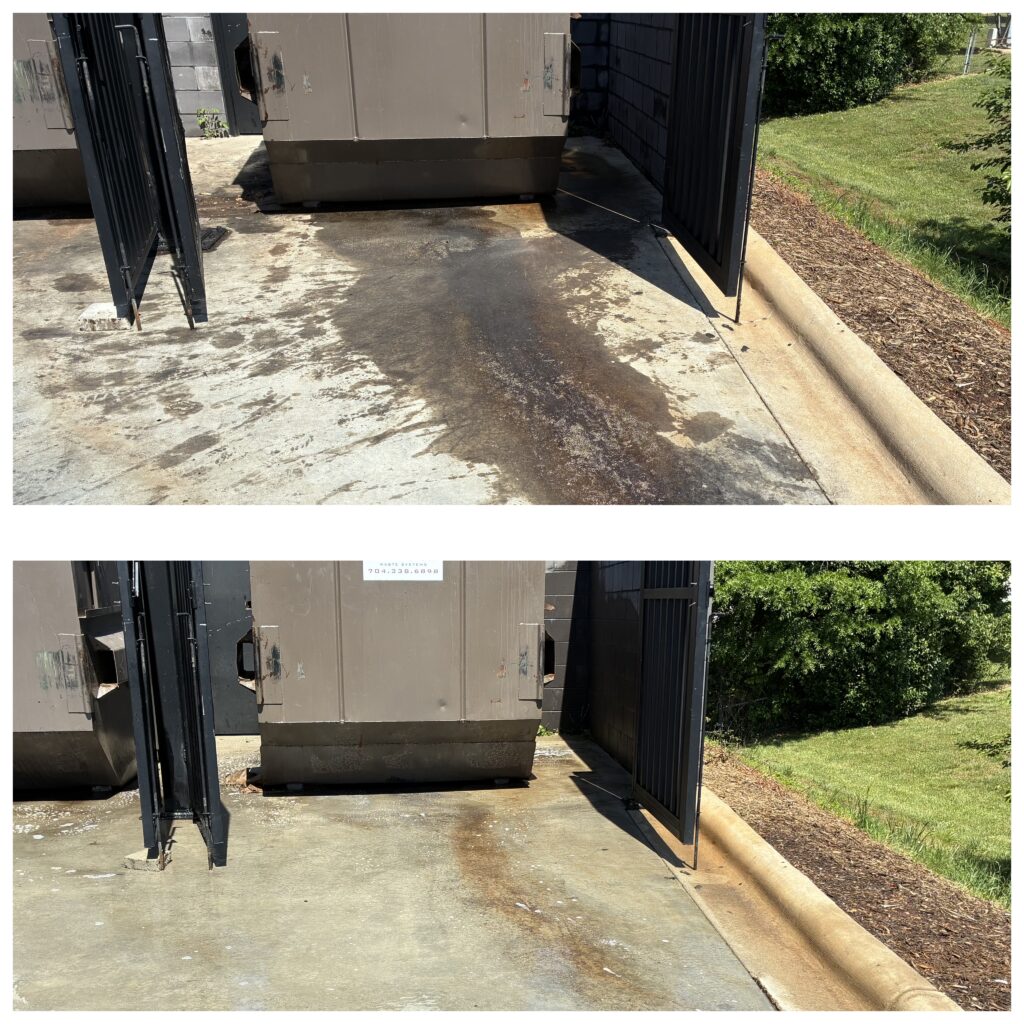
Finally, the crew walks the area with the manager again, points out what was cleaned, and notes anything that needs follow-up. Most jobs end with photo proof for the manager’s compliance file, which has become almost a standard ask from franchisors and insurance carriers.
What Does It Cost, and What’s the ROI on Monthly Service?
Pricing depends on the size of the pad, the dumpster footprint, whether the pad is enclosed, the cleaning frequency, and the access (some Uptown and South End loading docks are tight). A typical single-pad restaurant in Charlotte runs in the low-to-mid hundreds for a one-time clean, with monthly pricing dropping per visit because the build-up between visits is smaller.
The math gets more interesting when you set it against the cost of being wrong. A single FOG notice of violation starts around $500. A health inspection downgrade that puts you in the news on the Mecklenburg County restaurant report card can cost a week or more of dine-in revenue. A franchisor audit failure can put your renewal at risk. A pest control callback after a roach sighting in the dumpster enclosure can run hundreds on its own. Against any of those numbers, a fair monthly fee is the cheapest line on the P&L.
Power Wash Charlotte answers the phone, gives a same-day quote in most cases, and stands behind the work. If you need an emergency clean before an inspection or after a citation, we can usually be on site within a day or two. If you want a recurring schedule that quietly takes the dumpster pad off your manager’s plate, we will set that up and confirm every visit the day before.
Frequently Asked Questions About Dumpster Pad Cleaning in Charlotte
Does Power Wash Charlotte clean the dumpster itself?
We clean the pad, the enclosure walls, the bollards, and the surrounding concrete, not the inside of the dumpster container itself. Dumpster interiors are typically handled by the waste hauler or a specialty in-bin cleaning vendor. We coordinate around their schedule when needed.
What about the grease trap or grease bin?
Grease trap pumping is a separate service handled by a licensed grease hauler, not by a pressure washing company. We clean the area around the outdoor grease bin, including the concrete underneath and the pad it sits on. If your grease bin is leaking or overflowing, we will flag it so you can call your hauler before the FOG inspector finds it first.
Can you do the cleaning after hours so we don’t disrupt service?
Yes. A large share of our Charlotte restaurant work happens overnight or in the early morning, between close and prep. Our team brings its own water, its own light, and works quietly enough that nearby residential is rarely an issue. After-hours service is a small premium, but it is the standard arrangement for most full-service restaurants in NoDa, South End, and Uptown.
How quickly can you get out for an emergency cleaning before a health inspection?
For most of the year, we can be on site within 24 to 48 hours. During spring and summer peak weeks we may need a few extra days, but emergency pre-inspection requests are something we plan for. Call us as soon as you get word an inspection is coming, or as soon as a citation arrives, and we will work it in.
Is the wash water safe for the environment?
We use cleaning agents that are safe for landscaping, and we capture and route wastewater according to Charlotte Water’s FOG and stormwater rules. No pad runoff goes into a storm drain. The whole point of hiring a real vendor is that you do not have to worry about either the health inspector or the stormwater inspector showing up the next morning.
Need a quote for your home or property? Call Chris and the Power Wash Charlotte team at (704) 393-7773 or get your free quote.
By Chris Earll, Owner of Power Wash Charlotte
Chris Earll is the owner of Power Wash Charlotte (Cutting Edge Restoration Inc), serving the Charlotte metro since 1996. He and his team have completed thousands of residential and commercial pressure washing projects across Mecklenburg, Union, Cabarrus, Iredell, Gaston, Lancaster, and York counties.